

 10:55 am - April 29, 2026
A road winds around the western edge of the Coatepeque caldera, and if you pull over in the late afternoon at the right pullout, the lake below appears to be staged. Located approximately 250 meters below the surface, it is enclosed by walls that were created approximately 70,000 years ago by an explosion. Typically, the water is a deep, trouble-free blue. Then, without much notice, it isn’t every few years. Sometimes in a matter of days, it turns turquoise. Residents occasionally wake up to a different lake than the one they fell asleep next to because the shift is so sudden.
The most recent list of color changes, which includes 1998, 2006, 2012, then nearly yearly between 2016 and 2019, with another episode in 2022, reads more like a rhythm we don’t fully understand than a freak occurrence. This March, NASA’s Earth Observatory released a new astronaut photo of the lake in its serene blue that was taken from the International Space Station in February. The picture is stunning in the way that satellite photos can occasionally be. It also brings up the question that San Salvadorian geologists have been debating for years: what precisely is going on down there?
| Topic Snapshot | Details |
|---|---|
| Location | Coatepeque municipality, Santa Ana department, western El Salvador |
| Lake Surface Area | Roughly 26 km² (10 sq mi); maximum depth around 115 m (377 ft) |
| Caldera Origin | Formed by explosive eruptions between 72,000 and 51,000 years ago |
| Last Recorded Eruption | None during the Holocene (past 11,700 years), per Smithsonian’s Global Volcanism Program |
| Adjacent Active Volcano | Santa Ana (Ilamatepec) — last major eruption in 2005 |
| Documented Color-Change Years | 1998, 2006, 2012, 2016, 2017, 2018, 2019, 2022 |
| Most Cited Causes | Microalgae and cyanobacteria pigments; natural mineralization (per 2024 University of El Salvador research) |
| Recent Imagery | Captured Feb 10, 2026 by Expedition 74 crew aboard ISS, published by NASA Earth Observatory |
In the last 11,700 years, the Coatepeque caldera has not produced a single eruption, according to the Smithsonian’s Global Volcanism Program. The system is asleep by that measure. However, you should exercise caution when using the word “asleep.” The tallest volcano in El Salvador, Santa Ana, is clearly active and only a few kilometers away from the caldera. It last erupted in 2005. The lake’s edges are fed by hot springs. In a 2024 study from the Marine Toxins Laboratory, researchers from the Universidad de El Salvador came to the conclusion that the turquoise episodes are most likely caused by natural mineralization in the water, such as sulfates and calcium carbonate, which bubble up from below, along with blooms of microalgae and cyanobacteria that flourish when conditions favor them.
Therefore, it is important to handle the attention-grabbing version—”warning sign from deep inside the Earth’s crust”—carefully. The color changes do not appear to precede eruptions, according to published data. Additionally, there is no discernible seismic correlation. More subtly, the data does imply that there is still motion beneath. heat from geothermal sources. groundwater rich in minerals. The regular breathing of a volcanic system that has not completely stopped. The lake may be able to detect those minute movements more accurately than our instruments. It’s also possible that biology is primarily responsible for the changes, with geology playing a supporting role.
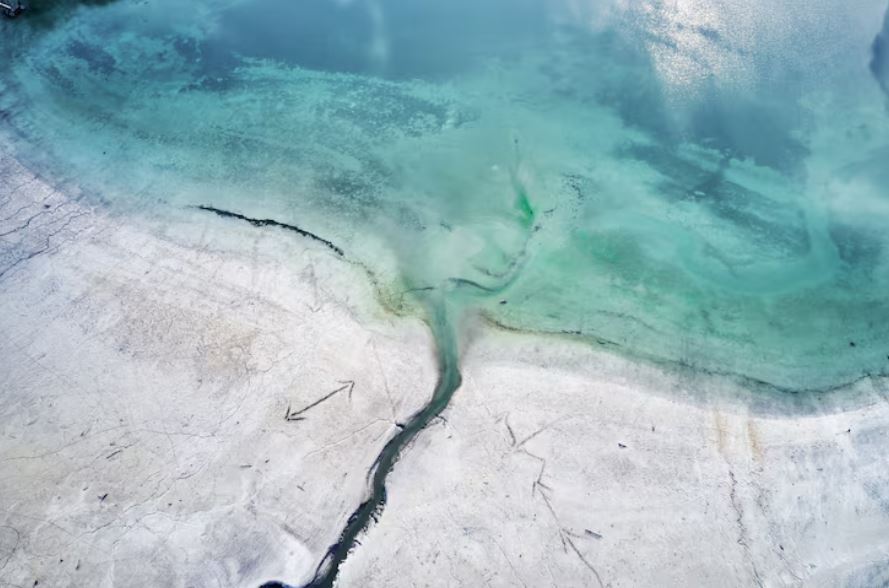
Walking along the shoreline close to the village of Coatepeque gives one the impression that the locals are more knowledgeable about the lake than scientists. Fertilizer, sewage, and seasonal rainfall have all loaded the lake in ways that make algal blooms more dramatic and the color shifts more noticeable, according to the Coatepeque Foundation, which has been monitoring water quality for years and has long maintained that runoff from the residences and eateries now lining the rim is making the system more sensitive. This is the story’s awkward part. Perhaps the larger lever is pollution rather than deep crust. The volcano angle is preferred in tourism marketing. There is sometimes disagreement between the water samples.
When you observe this from a distance, the magnitude of the unknowns is what sticks with you. There are more variables in a 7-kilometer-wide caldera with an average depth of 35 meters and a deepest depth of 115 meters than any monitoring network could possibly cover. Part of the reason the science is still weaker than the spectacle is that the nation has more urgent issues than a lake that occasionally turns turquoise. One of those questions that probably won’t be resolved until the lake or the nearby volcano provides an answer is whether or not that matters more than it appears.



