

 12:21 pm - April 16, 2026
The idea that one of the main barriers to humanity’s expansion into space may not be rocket propulsion, radiation shielding, or food production has an almost absurdly poetic quality. It could be sperm. In particular, the issue that human sperm completely lose their sense of direction in the weightless void of space—tumbling, flipping, and failing to find an egg in a way that raises some extremely unsettling questions about our aspirations to travel to other planets.
Researchers at the Robinson Research Institute at Adelaide University have now published what seems to be the first study of its kind: a controlled investigation into the possibility of sperm actually navigating the female reproductive tract in microgravity. In general, the answer is no. Or, at the very least, poorly.
Study & Institution Overview
| Study Title | Microgravity impairs sperm navigation and early embryo development |
| Published In | Communications Biology (Nature Portfolio) |
| Lead Researcher | Dr. Nicole McPherson, Senior Author |
| Institution | Robinson Research Institute, School of Biomedicine, Adelaide University |
| Collaborating Centre | Andy Thomas Centre for Space Resources, Adelaide University |
| Centre Director | Associate Professor John Culton |
| Species Tested | Humans, mice, and pigs |
| Key Equipment | 3D Clinostat Machine (developed by Dr. Giles Kirby, Firefly Biotech) |
| Fertilisation Reduction | ~30% fewer mouse eggs fertilised after 4 hours of simulated zero gravity |
| Human Sperm Navigation Drop | ~40% fewer microgravity-exposed human sperm completed the maze |
| Potential Countermeasure | Progesterone supplementation helped restore some navigational ability |
| Related Space Mission | NASA’s Micro-11 (2018) — human sperm sent to the ISS |
| Next Research Phase | Studying varying gravity levels — Moon, Mars, artificial gravity systems |
| Broader Context | Supports long-term planning for human reproduction in off-Earth settlements |
In comparison to the control group, about 40% fewer human sperm exposed to microgravity passed through the maze-like chamber. When you sit with that number, it’s shocking. Almost half is gone. Lost and confused.
The specificity of the mechanism discovered in this study sets it apart from previous space biology investigations. There was no physical impairment or sluggishness in sperm exposed to simulated zero gravity. They continued to travel at about the same speed. They simply couldn’t decide which way to go.
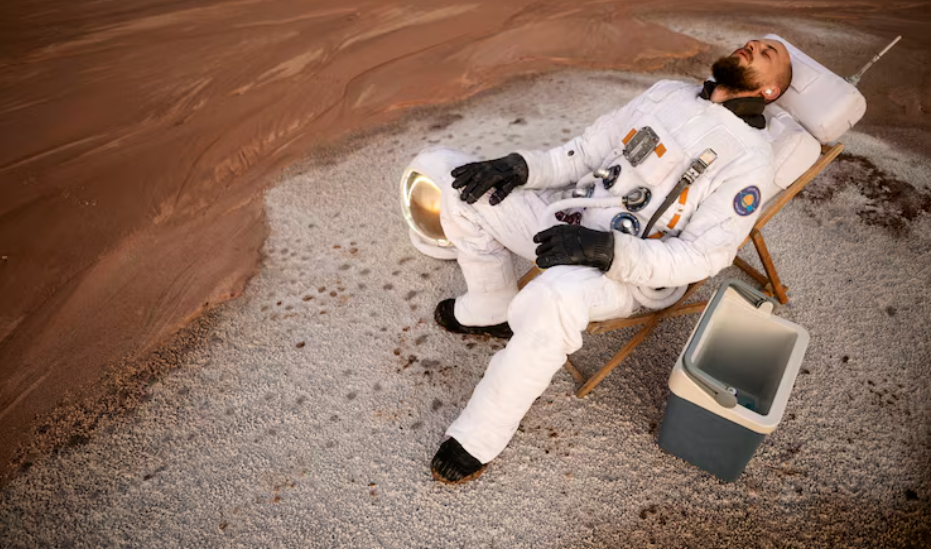
According to the study’s senior author, Dr. Nicole McPherson, the sperm “don’t really know which way is up or down.” It seems like we’ve been focusing on the wrong issue all along when we watch that phrase land. For decades, we have been concerned about how rockets will transport humans to Mars. What happens to biology once we arrive may be the more difficult question.
The group employed a 3D clinostat device created by Dr. Giles Kirby at Firefly Biotech, which simulates the disorienting free-fall of weightlessness by repeatedly flipping cells. After that, they ran human, mouse, and pig sperm samples through a chamber maze that was made to resemble the female reproductive system.


The navigational data alone revealed a clear story, but no human egg was placed at the end of the maze due to ethical restrictions. It was also depressing. The navigational failure was not unique to any one species; it was present in all three types of mammals, indicating a deeper issue than a peculiarity of human biology.
If anything, the embryo results were more depressing. After just four hours in simulated microgravity conditions, the rate of successful fertilization in mouse models decreased by about thirty percent. Long-term exposure worsened the situation by causing developmental delays and, in certain situations, a discernible decrease in the cells that eventually form the fetus.
The precise reason why extended exposure exacerbates the harm is still unknown, and scientists are only now starting to consider the possibility of a threshold effect—a point at which the lack of gravity turns from tolerable to extremely dangerous.
The study has one thread of cautious optimism that is worth considering. Even in microgravity, the addition of progesterone, a sex hormone essential for initiating pregnancy, made it easier for human sperm to navigate the maze. Progesterone, which is naturally released by eggs, may serve as a chemical compass for sperm even in the absence of gravitational cues.
It is completely unclear if this could be turned into a useful intervention for space reproduction. However, it’s something. It implies that the biological system isn’t entirely malfunctioning, but rather has been deprived of a cue that it seems depends on far more than anyone had realized.
Studying reproduction in space has a long history, but most of it has stayed on the periphery of mainstream science. Experiments conducted on Cosmos 1887 in 1987 revealed that rats exposed to space had smaller testicles. In 1998, mouse embryos were launched aboard the Columbia shuttle. In order to investigate how weightlessness affects human sperm on the International Space Station, NASA launched its Micro-11 mission in 2018.
However, none of those earlier studies looked at whether sperm could truly move through a reproductive channel in controlled microgravity, as the Adelaide team notes. This research has now begun to close that gap, which is impressive in hindsight.
The stakes are real. NASA’s Artemis mission program, which aims to send humans back to the Moon and eventually Mars, already includes Australia. Timelines for human settlement on Mars have been outlined by SpaceX, albeit they are speculative. The Andy Thomas Centre for Space Resources at Adelaide University’s director, Associate Professor John Culton, put it simply:
“As we progress toward becoming a spacefaring or multi-planetary species, understanding how microgravity affects the earliest stages of reproduction is critical.” That statement carries weight as a sincere declaration of urgency from people who have dedicated their careers to considering what it would truly take to live off Earth, rather than as a press release boast.
The next stage of the Adelaide study will examine different gravitational environments; the surface gravity of Mars is approximately one-third that of Earth, while that of the Moon is about one-sixth. The kind of question that could completely change how we design future habitats and artificial gravity systems is whether those intermediate levels are adequate to support normal sperm navigation and embryo development or whether there is a sharp drop-off threshold. It’s the kind of question that probably seemed like science fiction ten years ago. It doesn’t anymore.
In space, human sperm get lost. It’s an odd sentence to have at the heart of something so important. But here we are, and perhaps more than most, the researchers who spent years creating mazes and simulating weightlessness in an Adelaide lab are thinking clearly about what human life in the cosmos would truly require.