
 8:46 am - April 19, 2026
You’ll notice something that doesn’t quite add up if you stroll through a mid-range mall on a Tuesday afternoon in practically any American city right now. As is typical for a weekday, the parking lot is half full. The stores aren’t empty inside, though. Some customers are spending eighty dollars on serums they found on TikTok at the Sephora counter. At the Nike store, a twenty-something is holding two boxes of sneakers and choosing between them with the casual consideration of someone who hasn’t just looked at their bank account. A couple is eating Shake Shack near the food court and discussing whether to plan a trip to Portugal before airfares become more costly. By most accounts, the economy is causing people to feel uneasy. And yet. Spending is still ongoing.
For the better part of two years, U.S. retail figures have been subtly supported by this doom spending. As befits a generation that grew up naming behavioral phenomena they saw in themselves, often more clearly than the economists who study them, Gen Z is credited with coining the term itself. The definition is straightforward: spending money you don’t necessarily have on items you don’t necessarily need because the future seems uncertain and purchasing something gives you a brief sense of control that the macroenvironment does not. Almost 27% of Americans acknowledge engaging in this behavior. The percentage rises to 39% among millennials. It is 37% among Gen Z. Additionally, 40% of respondents claimed to have increased their spending from the previous year.
| Doom Spending in the U.S. — Key Data & Context | |
|---|---|
| Term Origin | Coined primarily by Gen Z; popularized widely from late 2023 onward |
| Definition | Spending money despite economic anxiety — on luxury items, experiences, or goods — as a stress-coping mechanism |
| Share of Americans Doom Spending | 27% of all Americans — 39% of millennials, 37% of Gen Z |
| Americans Concerned About Economy | 96% (Intuit Credit Karma survey) |
| U.S. Credit Card Debt (Q3 2024) | $1.17 trillion — record high (Federal Reserve Bank of New York) |
| Americans with Less Than $2K in Savings | 52% |
| Americans Who Have Taken on Debt (6 months) | 32% — 27% attributing it to increased spending |
| Holiday Sales 2023 (NRF) | $964.4 billion — up 3.8% year-over-year |
| Gen Z “Chronically Online” | 70% — constant exposure to negative news cited as spending trigger |
| Buy Now, Pay Later (BNPL) Growth | 40% increase in users over two years; currently ~9% of consumers |
| Tariff-Driven Panic Buying (2025) | ~20% of Americans buying more than usual due to tariff fears (CreditCards.com) |
| Consumer Sentiment Trend | University of Michigan index fell for four consecutive months through early 2025 |
| Adults Under 25 Living With Parents | 57% — reducing fixed costs but not curbing spending |
| Further Reference | Federal Reserve Consumer Credit Data |
The economic environment is important. According to a recent Intuit Credit Karma survey, 96% of Americans expressed concern about the state of the economy. The uncertainty is real and quantifiable; it includes housing costs, inflation, wages that haven’t kept up, and now a tariff environment that changes every week. Through early 2025, the University of Michigan’s consumer sentiment index declined for four consecutive months. The difficulty is not being imagined by people. The problem with traditional economic models is that people are expected to reduce their spending when they feel threatened financially.
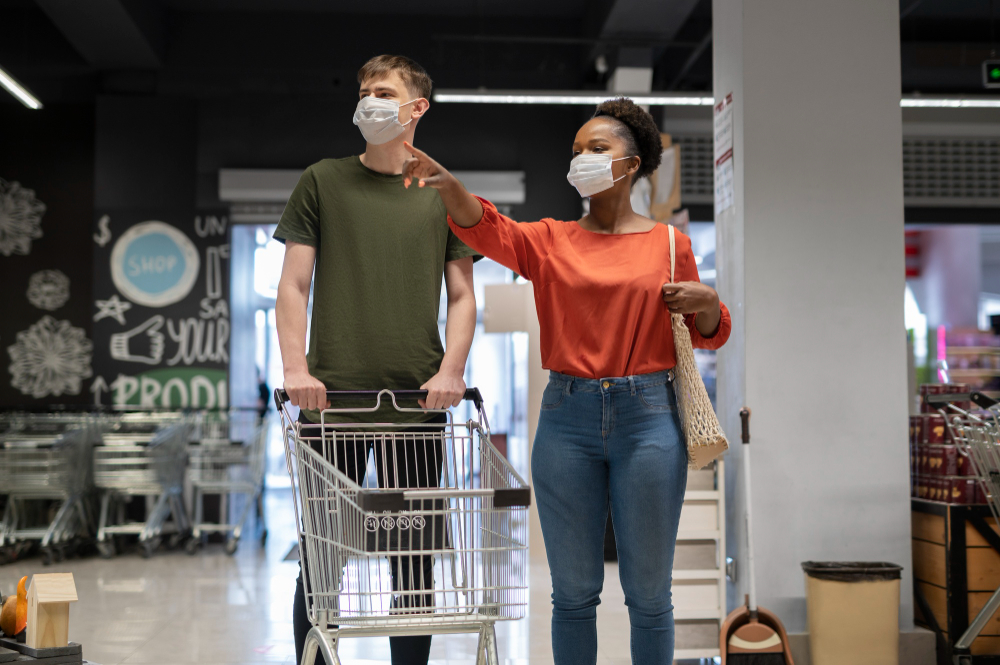
Make more savings. Get ready. Rather, a sizable segment of the American consumer base is acting in the opposite way, and the revenue figures for the retail industry indicate that this isn’t a specialized practice. In 2023, holiday spending totaled $964.4 billion. Over the weekend of Black Friday through Cyber Monday, a record 200 million customers showed up. The figures don’t suggest that the nation is preparing for a recession. They appear to be a nation that is overindulging in stress.
In 2025, a new layer has been added by the tariff dimension. According to a CreditCards.com survey, about 20% of Americans said they were purchasing more than usual, specifically to avoid potential price increases once tariffs fully take effect. Large, durable purchases like cars, furniture, appliances, and home improvement supplies are being pushed forward in time by the fear that waiting will result in higher costs. Consumer behavior is similar to what occurred during the early pandemic, according to a University of Wisconsin economics professor: people spend in anticipation of restrictions, then again when those restrictions are lifted, and again because the uncertainty never truly goes away. “The ‘doom’ part,” he stated, “conveys to me the expectation that people are really anticipating an economic slowdown, if not an outright recession.” The amazing thing is that actively shopping and foreseeing a recession have proven to be completely compatible.
The ledger that records all of this is credit card debt, which was $1.17 trillion as of the third quarter of last year. Forty-seven percent of Americans claim that their savings have declined. Fifty-two percent have savings of less than $2,000. These figures and the Tuesday afternoon numbers from the mall are part of the same reality, which is either a deep irony or a perfectly normal human reaction to feeling stuck. Research dating back to the early 2000s indicates that individuals who have little control over their financial outcomes are both more likely to realize they should save money and less likely to do so. In some ways, doom spending is a logical extension of that discovery: if the future seems structurally unattainable, the only sensible course of action is to maximize the present.
The retail sector seems to have instinctively grasped this and organized itself appropriately. Buy now, pay later platforms, which saw a 40% increase in users over the course of two years, make the transaction so seamless that choosing to spend hardly even counts as a decision. The actual exchange was reduced to a gesture by mobile payment systems. People who are already primed by anxiety are served luxury content by social media algorithms, effectively completing the cycle. A financial educator is describing a purposefully designed frictionless path from impulse to purchase when she says that spending money has become as simple as waving your phone over a reader. Although they did not create doom spending, retailers have undoubtedly made it simpler to engage in.


How long consumer spending can stay high in these circumstances is still unknown. Rates of credit card delinquency have been rising. A future expense that is not included in the current Sephora purchase is represented by the balances accumulating at 20% interest. For various reasons, retailers, economists, and credit card companies are all keeping a close eye on whether the doom spending eventually gives way to a spending contraction—the belt-tightening that the sentiment surveys have been predicting for months—or whether American consumers continue to defy the models. For now, Tuesday afternoon at the mall appears to be going well. It’s a different story entirely if it appears that way in October.