

 9:39 am - April 1, 2026
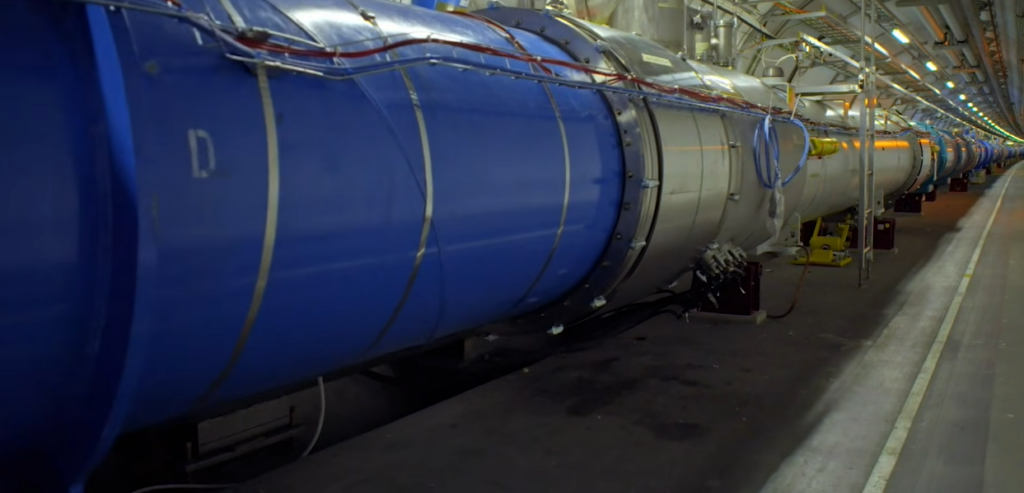
At CERN, the air frequently hums with an odd silence, as though the machines are holding their breath. Something unexpected has begun to emerge deep beneath Geneva, where protons regularly collide at almost the speed of light. Now, physicists researching these high-energy collisions must deal with anomalies for which they were never adequately prepared by conventional textbooks.
The muon, which has long been regarded as an electron’s dependable but somewhat heavier cousin, is one of the most fascinating. Scientists are now forced to halt due to its behavior, which was recently shown to deviate from theoretical expectations by 5.2 sigma. This footnote is not insignificant. Physicists refer to a result with that degree of statistical weight as discovery-grade. If true, this type of discovery has the potential to change our perception of the tiniest moving components in reality.
It’s not only the muons, though.
| Key Detail | Information |
|---|---|
| Event | CERN physicists detect anomaly that contradicts Standard Model predictions |
| Location | Large Hadron Collider (LHC), CERN, Geneva |
| Key Findings | Strange Higgs boson decays, unexpected muon behavior, exotic tetraquarks |
| Statistical Significance | Muon decay anomaly reaches 5.2 sigma—discovery threshold |
| Implications | Possible evidence for new particles, hidden forces, or dark matter |
| Methods | AI-driven anomaly detection, soft unclustered energy searches |
| Future Outlook | May require rewriting particle physics’ foundational framework |
According to reports, the Higgs boson, which was previously the Standard Model’s crown jewel, is acting strangely in its decay patterns. It has been branching into combinations that imply something else is hiding behind the curtain rather than following the expected script and decaying into well-known, well-understood particles. Even though this behavior is currently being carefully examined, it is getting harder and harder to explain with current physics.
Another strong piece of evidence, tucked away between pages of recent internal briefs, is that exotic particles like pentaquarks and tetraquarks are no longer uncommon flukes. A richer subatomic rainforest than previously thought is suggested by their repeated finding in the LHC. The model that dominated particle physics for decades does not easily accommodate these odd quark pairings.
During a lab tour, I recall an Italian researcher remarking, “This is where theory goes to retire,” as he looked at a scatter plot with subtle variances. I was struck by how casually he stated it, as though he were trying to avoid the gravity of what that narrative may entail.


Despite its sophisticated formulas and high predictive power, the Standard Model was never intended to be the last word. The interaction between particles is remarkably obvious—until it isn’t. Notably, there is no gravity. Dark energy and dark matter are regarded as incidental. Furthermore, one of the model’s more unsettling silences is still the strange mass of neutrinos.
The stillness is beginning to dissipate.
To find patterns that the human eye would overlook, researchers are using extremely effective machine learning algorithms that have been trained on petabytes of data. Finding “soft unclustered energy patterns”—whispers in the noise that can indicate a “hidden valley” as some refer to it—is one such technique. According to this theory, there is a whole parallel sector of particles and forces that interacts with known matter only weakly.
Physicists have greatly decreased the likelihood of overlooking weak, non-conforming interactions by utilizing this method. This type of data-driven analysis is incredibly successful in transforming ambiguous anomalies into signals that can be replicated. CERN has also broadened its theoretical framework by forming strategic alliances with research teams in North America and Asia, adding predictions that previously appeared too speculative for serious investigation.
Leptoquarks, particles that would unexpectedly link the behavior of leptons and quarks, are suggested by certain theories. Others envision changed gravity frameworks, additional dimensions, or even unidentified bosons. Every possibility prompts a fresh path of inquiry and serves as a reminder that science benefits more from ambiguity than from certainty.
The transparency culture is one area that has significantly improved. Teams now share datasets, publish their models, and encourage external scrutiny, in contrast to previous decades when audacious assertions were frequently guarded. In this new era of teamwork, advancement happens more quickly. Researchers have greatly accelerated the process by incorporating anomaly detection directly into the LHC’s real-time analysis, which enables them to make adjustments to experiments virtually instantly.
As labs around the world closed or reduced their operations during the epidemic, CERN covertly updated its detectors and used new technologies to reprocess historical data. That intentional pause was quite helpful. It gave physicists a chance to take stock, think, and be ready for this chapter—one of transformation rather than confirmation.
As I read a synopsis of Higgs decay anomalies, I stopped and felt a glimmer of admiration for both the particle and the patient intellect who were attempting to unravel its mysteries.
There is cautious optimism even among experienced physicists. These findings are dispersed throughout multiple systems, timelines, and decay mechanisms, in contrast to previous anomalies that diminished when examined. They are durable because of their diversity. They bear the weight of a field gradually turning in the direction of something new, even though it is not yet definitive.
Now, the most progressive voices ask: What if the Standard Model is intentionally flawed rather than flawed? Similar to a comprehensive map of a single continent, it is helpful but constrained if you believe there are still islands and oceans to map.
We might see a change in the next few years from validating preexisting theories to creating audacious, comprehensive frameworks. Long written off as speculative, supersymmetry might make a comeback. Experimentation with AI support may become the new norm. Furthermore, if these patterns persist, the next big discovery may not be a new particle but rather a whole different perspective on the ones we already know.

