

 8:08 am - April 11, 2026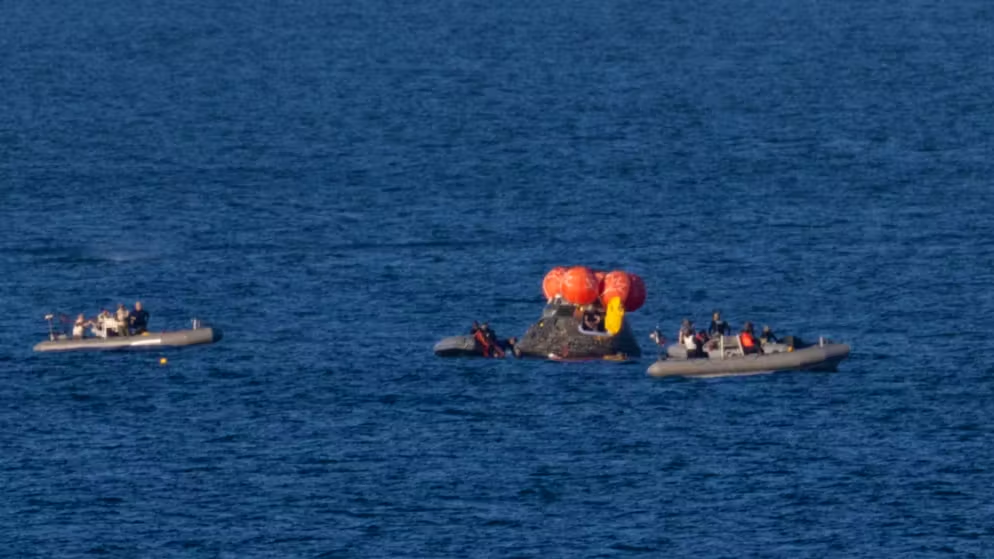
A mission that is not just a return to the Moon, but a decisive test to gauge how ready humanity truly is to explore deep space.
A launch that marks a new balance in space
The launch of Artemis II from the Kennedy Space Center at 6:35 p.m. ET on April 1, 2026, was not merely a technical event. It was a symbolic gesture, almost a declaration of intent. After years of development and testing, NASA sent a human crew beyond low Earth orbit, venturing onto a lunar trajectory that directly echoes the legacy of the Apollo missions, but with incomparably greater technological complexity.
The Orion spacecraft, designed to accommodate astronauts for extended periods with full autonomy, carried Reid Wiseman, Victor Glover, Christina Koch, and Jeremy Hansen. The mission covered approximately 695,081 miles, a distance that surpasses even some of the Apollo program’s most daring historical trajectories. On board, every system was monitored with almost surgical precision, including minor technical alerts such as a temperature fluctuation in a battery of the launch abort system, which was later deemed non-critical. It is in these details that the maturity of a mission is measured.
The lunar trajectory and the significance of the fly-by
The scientific heart of Artemis II is its lunar fly-by, a maneuver that does not involve a lunar landing but a close fly-by of the Moon. This choice is not prudence, but strategy. It allows for the testing of all vital systems in deep-space conditions without the added risk of descending to and ascending from the lunar surface. This is where the true innovation of the Artemis program comes into play: the establishment of a sustainable presence in cislunar space.
The Orion module, attached to the SLS (Space Launch System) rocket, represents one of the most advanced platforms ever built for crewed missions. To understand its structure and role, it is helpful to explore the concept of Orion (spacecraft), which combines life support systems, autonomous navigation, and radiation protection. The mission’s trajectory is not merely a physical path but also a realistic simulation of the conditions astronauts will face on future missions to Mars.
Reentry and the logic of “controlled success”
The splashdown in the Pacific Ocean, which occurred at 8:07 p.m. ET on April 10, marked the conclusion of the mission in a definitive yet unspectacular manner. And this is important. In modern missions, success is no longer measured by visual spectacle, but by the repeatability and safety of procedures. The return of the Orion capsule, followed by the crew’s recovery by helicopter and transfer to the USS John P. Murtha, confirmed the system’s robustness.


There is a deeper interpretation to be made. Artemis II is not a destination, but a test of psychological and technical endurance. The astronauts spent ten days in relative isolation, far from Earth’s orbit, in an environment simulating the future conditions of interplanetary missions. NASA is already speaking of a “new era of exploration,” but the real news is more understated: everything worked as planned. And in space, that is the highest form of success.
Frequently Asked Questions
Did Artemis II land on the Moon? No, the mission performed only a lunar flyby without a landing.
How long did the mission last? About 10 days, with a splashdown in the Pacific Ocean.
What was the role of the Orion capsule? To transport and protect the crew during the journey into deep space.
Were there any technical issues during the mission? Only minor alerts, such as a temperature fluctuation in a battery, with no operational impact.
Why is this mission important? It serves to test systems and procedures for future lunar missions and, eventually, missions to Mars.

