

 9:01 am - April 2, 2026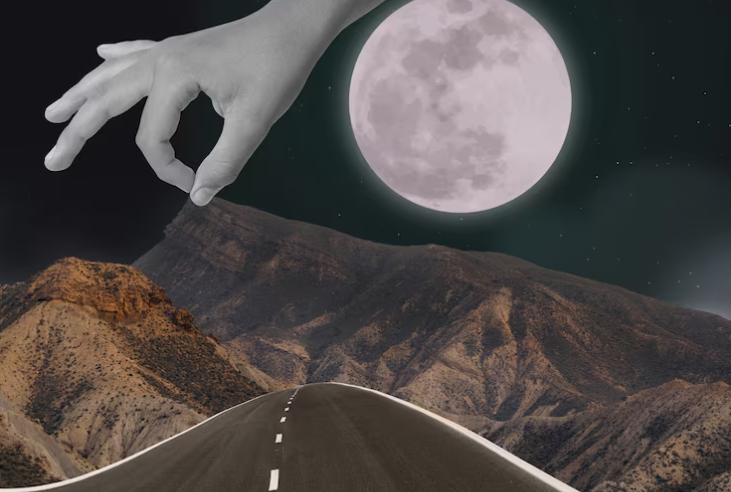
There is something quietly humbling about a full moon rising over the eastern horizon. It doesn’t matter how many times you’ve seen it — the moment still pulls at something old inside you. This April 1st, that feeling returns with a moon that carries centuries of human meaning packed into its pale, golden glow. The Full Pink Moon. And no, despite what the name promises, it will not be pink.
That small contradiction is part of what makes this particular full moon so interesting to think about. The name comes not from the moon itself but from the earth below it. Creeping phlox — Phlox subulata, a dense, low-growing wildflower with bright hot-pink blooms — carpets the slopes of eastern and central North America right around the time April’s full moon rises.
| Feature | Details |
|---|---|
| Event Name | Full Pink Moon 2026 |
| Date of Peak | April 1, 2026 |
| Peak Time (ET) | 10:12 p.m. Eastern Time |
| Moon Type | Micromoon (near apogee) |
| Apparent Color | White to golden hue (not pink) |
| Named After | Creeping Phlox (Phlox subulata) wildflower |
| Religious Significance | Paschal Moon — determines date of Easter |
| Jewish Connection | Marks beginning of Passover (15th of Nisan) |
| Visibility | Northern and Southern Hemispheres |
| Best Viewing Tip | Open area, low eastern horizon, binoculars optional |
| Notable Star Nearby | Spica (constellation Virgo) |
| Next Full Moon | May 12, 2026 — Flower Moon |
| Reference Website | Old Farmer’s Almanac |
According to the Old Farmer’s Almanac, early observers connected the sky event to the flowering landscape beneath it, and the name stuck. It’s the kind of poetic, grounded logic that modern science rarely bothers with anymore, but probably should.
Standing outside on a clear April night, looking up at what appears to be a perfectly ordinary white-gold orb, it’s worth pausing to consider just how many different people across different centuries assigned their own meaning to this same light. Native American tribes gave the April moon names rooted in direct observation of the natural world.
The Tlingit called it the Budding Moon of Plants and Shrubs. The Algonquin named it the Breaking Ice Moon. The Cree called it the Frog Moon. The Dakota described it as the Moon When the Streams Are Again Navigable. Each name is essentially a field note from a people paying close attention to the world around them — something most of us have mostly stopped doing.
The science behind this year’s Pink Moon adds its own layer of interest. April’s full moon is technically a micromoon, meaning it arrives near apogee — the farthest point in the moon’s elliptical orbit around Earth. NASA planetary scientist Dr. Noah Petro, who leads the science team for the Artemis III mission, has pointed out that the moon’s orbit is egg-shaped rather than circular, which means its distance from Earth changes throughout the year.


This April, the moon will be roughly 30,000 miles farther from Earth than November’s supermoon will be. It’s possible most casual observers won’t notice — the size difference is subtle enough to miss with the naked eye — but through binoculars or a camera lens, the contrast is real.
There’s a quiet irony in the timing. April 1st is April Fool’s Day, and the joke the sky seems to be playing is offering a moon that announces itself as pink while arriving golden, and full while being at its smallest of the year. It’s the kind of detail that makes you wonder whether ancient sky-watchers had a sense of humor about it too.
The religious implications of this moon are perhaps less well known but genuinely fascinating. In Christian tradition, the Pink Moon is the Paschal Moon — the first full moon following the spring equinox — and it directly determines the date of Easter. Easter falls on the first Sunday after this moon rises, which places it on April 5th this year. The Eastern Orthodox tradition follows slightly different calculations, landing on April 12th.
Meanwhile, in Jewish tradition, the same full moon marks the beginning of Passover, the 15th day of the Hebrew month of Nisan — a connection that’s purely astronomical, rooted in the lunisolar structure of the Hebrew calendar. It’s hard not to notice how many different spiritual traditions ended up organized around the same point of light in the night sky, each arriving at that convergence through entirely separate paths of reasoning.
For those planning to actually step outside and watch it rise, the practical advice is simple. Find open ground away from city lights. Face east or southeast as the sun goes down. Wait. As the moon climbs over the horizon, it will appear larger than it actually is — a phenomenon called the moon illusion, caused by the brain comparing the moon to objects on Earth rather than to empty sky. It looks massive and close. It isn’t, quite — but the feeling is real enough.
This year there’s a bonus for patient observers: the bright star Spica, in the constellation Virgo, will hang just beneath the Pink Moon on the night of April 1st. The following evening, April 2nd, the moon will drift to within less than two degrees of Spica, offering one of those small, precise moments that reward people who actually look up.
Eight more full moons follow before the year ends, including three supermoons in October, November, and December. But there’s something about the first full moon of spring — the one that has been named and watched and argued over for thousands of years — that feels worth marking separately.
Not because it’s the biggest or the brightest, but because it arrives carrying so many layers of human attention. Wildflowers. Orbital mechanics. Religious calendars. Frog songs. All of it, somehow, pointing at the same pale light crossing the April sky.