

 9:29 am - March 27, 2026
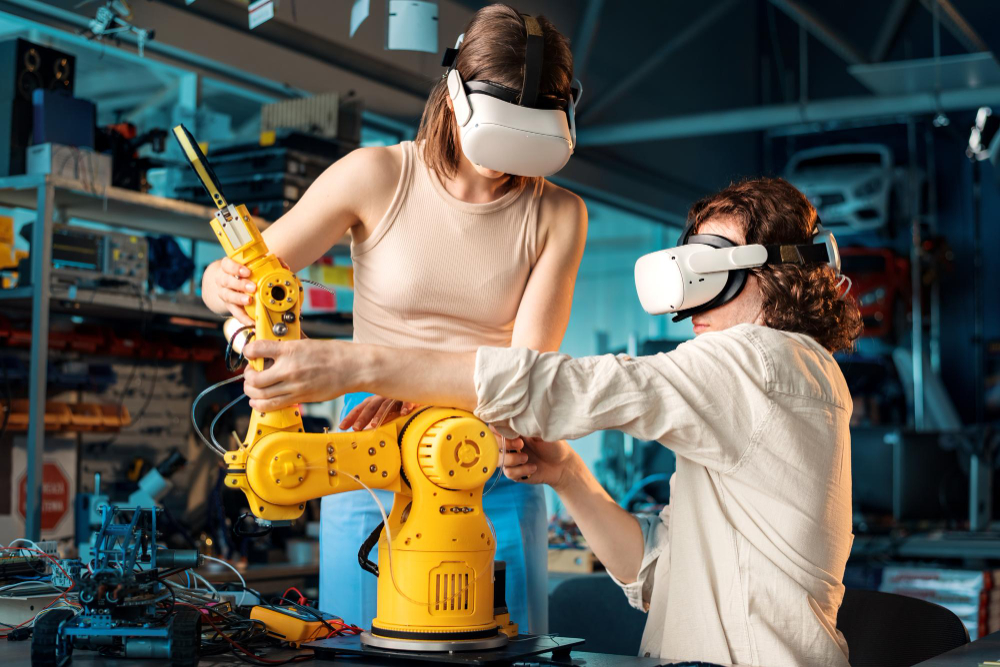
The customer service team at a company called Label Apeel spent several nervous months witnessing the arrival of new automation equipment on the floor of a mid-sized manufacturing facility in northern England. On an assembly line working eight hours a day, the machines were accurate, quick, and tireless—everything a human hand isn’t. As is nearly always the case, the employees assumed that the machines would take their jobs. Instead, a more complex and, in the end, more instructive process took place: employees moved toward more customer-facing, judgment-heavy tasks that the machines were unable to perform, while automation took over the repetitive parts of the work. No one lost their job. The position’s nature evolved. And that is the story that is currently unfolding throughout the world economy in miniature.
Workers’ skills are evolving due to automation. It’s a clear statement that is constantly undervalued. In January 2026, the International Monetary Fund released an analysis based on millions of online job postings in both advanced and emerging economies. The analysis revealed that one in ten job postings in advanced economies now require at least one skill that was not necessary ten years ago. It is one in twenty in emerging market economies. When you consider the scale, the number may seem small, but when you apply it to the whole labor market of the United States, Germany, or Japan at the same time, one in ten is a huge number. Telecare and digital health expertise are in high demand in the healthcare industry. In ways they didn’t even monitor five years ago, marketing departments are placing a higher priority on social media fluency. Over half of all new-skill demand in all measured sectors is accounted for by IT.
| Category | Details |
|---|---|
| Topic | How automation and AI are reshaping skill demands in the global workforce |
| Key Statistic | ~40% of global jobs exposed to AI-driven change (IMF, January 2026) |
| New Skills in Job Postings | 1 in 10 job postings in advanced economies require at least one new skill |
| Wage Premium (UK) | Roles requiring 4+ new skills pay up to 15% more |
| Wage Premium (US) | Roles requiring 4+ new skills pay up to 8.5% more |
| Employment Effect | Regions with high new-skill adoption saw 1.3% employment rise per 1pp increase in new-skill job postings |
| AI-Vulnerable Occupations | Employment in AI-vulnerable roles is 3.6% lower after 5 years in high-AI-demand regions |
| Employer Plans | 87% of global employers plan to retain or increase headcount despite automation (ManpowerGroup) |
| Manufacturing Change | 49% of manufacturing jobs expected to change in coming years |
| Best-Prepared Countries | Finland, Ireland, Denmark (IMF Skill Readiness Index) |
| Reference Website | IMF Blog — New Skills and AI Are Reshaping the Future of Work |
This shift’s wage data is startling and deserving of careful consideration. Jobs in the UK that require at least one new skill typically pay 3% more than similar positions that do not. Up to 15% more money is paid for jobs requiring four or more new skills. The premium for multiskill positions in the US is approximately 8.5%. These are not insignificant variations; over the course of a career, a 15% wage advantage at the time of hiring amounts to a significant difference in lifetime earnings. Additionally, the IMF researchers discovered that these premiums have a knock-on effect: workers with higher incomes typically spend more locally, which encourages hiring in service industries and increases employment in the surrounding areas. For every percentage point increase in the percentage of job postings requiring new skills over the previous ten years, employment increased by 1.3% in US regions with higher adoption of new-skill job postings.
What’s going on in the middle is what complicates the otherwise positive picture. High-skilled workers are making more money. In some industries, low-skilled workers are either staying the same or finding new opportunities. However, middle-skill jobs—routine office jobs, administrative tasks, and clerical positions that served as the cornerstone of steady middle-class employment for generations—are being squeezed in ways that aren’t entirely evident in overall employment figures. These are the jobs where the cost case for replacement is most obvious and automation is most effective. The cost of a robotic arm on an assembly line is the same at 9 a.m. and overnight. Health insurance is not required. The infrastructure for retraining workers displaced from these roles is still far thinner than what the challenge demands, and they are not automatically transitioning into higher-skill roles.
It’s difficult to ignore the fact that businesses that stopped viewing hiring as a just-in-time process and began considering talent as something you develop over time are the ones making this shift most successfully. 87% of employers worldwide intend to maintain or even grow their workforce in spite of automation, according to ManpowerGroup’s research, which tracks employers in dozens of nations. That figure may seem counterintuitive until you realize that the businesses that are automating the fastest are also the ones that are expanding the fastest, and even when machines are doing more work, people are still needed for growth. In the near future, 49% of positions in the manufacturing sector are expected to undergo significant change rather than disappear. For the workers who experience it, the distinction is very important.
Additionally, an awkward dynamic is developing, particularly in relation to AI and entry-level employment. After five years, employment levels in AI-vulnerable occupations are about 3.6% lower in high-AI-demand regions than in regions with lower demand for those skills, according to the IMF analysis. Early data from the US labor market indicates that entry-level hiring is declining due to the use of generative AI, especially for tasks that are easily automated. The lower rungs of career ladders that generations of workers used to advance to higher-paying positions are blocked by this particular shape. There are fewer jobs available for the young person who would have spent two years learning the business in a junior analyst role. It’s still unclear what will take the place of that entry path.


According to the IMF’s Skill Readiness Index, the nations that are managing this shift the best have one thing in common: steady investment in postsecondary education and lifelong learning initiatives that change as technology advances. Denmark, Finland, and Ireland are the top three. These three nations share a policy commitment to treating skill development as an ongoing public investment rather than a one-time credential, rather than a specific industrial base or distinctive geography. Despite housing many of the businesses spearheading automation, the US and UK score significantly lower on workforce readiness in relation to their economic size. In areas that can least afford it, the gap between what is being automated and what workers are prepared to do in its place is growing.


