

 10:11 am - March 25, 2026
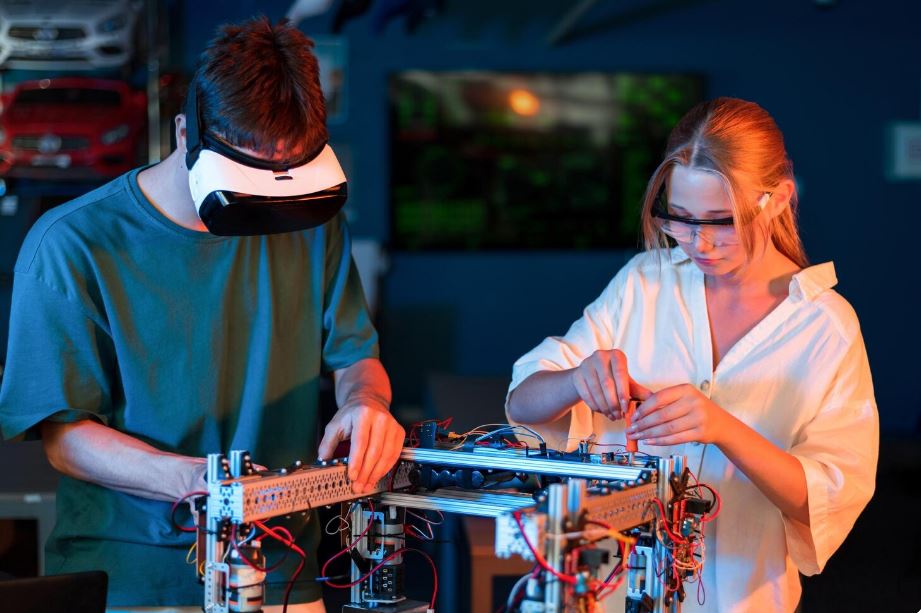
When the term “frontier models” first appeared in engineering hallways, it sounded a little bit like marketing. However, the phrase now has significance in a San Francisco warehouse that has been converted, where servers work behind glass partitions. Engineers watch models refine code, draft experiments, and sometimes surprise their creators while keeping an eye on dashboards that glow midnight blue. There’s a feeling that something subtle is taking place, a slow rewriting of presumptions about progress rather than an abrupt revolution.
The most sophisticated AI systems constructed with massive amounts of data, processing power, and custom silicon are referred to as frontier models. These systems are being advanced by companies like OpenAI and Google DeepMind, which treat them more like infrastructure than software. It’s difficult to ignore the physicality when strolling through data center campuses, which are expansive structures encircled by cooling towers. These days, artificial intelligence has a subtle scent of cold air and hot metal.
| Category | Details |
|---|---|
| Concept | Frontier Models |
| Leading Organizations | OpenAI, Google DeepMind, Anthropic |
| Key Figures | Demis Hassabis, Sam Altman, Satya Nadella |
| Era | “Scaling Era” of artificial intelligence |
| Core Idea | Large-scale AI models improving with compute and data |
| Infrastructure | Massive data centers, custom silicon, energy-intensive training |
| Potential Impact | Automation, research acceleration, new economic structures |
| Debate | AGI timelines, safety, governance |
| Reference Website | https://www.deepmind.com |
It took time for science fiction to become operational reality. For many years, artificial intelligence (AI) was primarily found in science fiction: machines that could reason, help, or even rebel. The frontier models of today seem more significant but less dramatic. They contribute to drug discovery, create research hypotheses, and write code. Investors appear to think that this is just the start. However, researchers are feeling more wary, even unsure.
Frontier models have a surprisingly straightforward scaling logic. Performance increases as more data, computation, and parameters are added. Surprisingly, this empirical rule has held true. Nevertheless, some engineers discreetly acknowledge that they don’t fully comprehend why. It feels less like engineering and more like gardening to watch a model get bigger: nurture conditions, watch growth, and hope for the best.
Executives frequently discuss “countries of geniuses on a datacenter” during strategy meetings. The metaphor sticks even though the phrase seems over the top. A single model can help thousands of workers at once with data analysis, report writing, and design exploration. Productivity increases from such systems may be comparable to previous industrial breakthroughs. However, the course of history is rarely clear-cut.
Tension is also present. Frontier models are very energy-intensive. Data centers negotiate water and power contracts as they spread into rural areas. Sometimes locals are the first to notice a change before legislators. Security fences are erected, trucks arrive, and fiber lines are installed. This type of progress is physical and occasionally disruptive.


Where this goes is a matter of debate among researchers. Some, such as Demis Hassabis, discuss reasoning systems that are able to plan and make scientific discoveries. Others contend that when scaling reaches its limits, progress will slow. Whether frontier models will develop into general intelligence or plateau into specialized tools is still up in the air. Perhaps the excitement is fueled by the debate’s sense of unresolvedness.
Frontier models are changing the cultural perception of work. AI-generated code is now reviewed by programmers. Generative systems and designers work together. Models are used by scientists to suggest experiments. The boundary changes, but humans are still in charge. This is a subtle dynamic. As this develops, it seems more like supervision than authorship.
It is more difficult to determine the economic ramifications. Some executives anticipate enormous increases in productivity. Others caution about unequal advantages. Both precedents can be found in history. Both wealth and dislocation were brought about by the industrial revolution. Frontier models may take a similar route, increasing productivity while posing concerns about employment and competencies.
A philosophical undertone is also present. In the past, science fiction depicted intelligence as dramatic and far away. Frontier models make it quieter and closer. They don’t speak or move in a dramatic manner. They compute probabilities while seated in hardware racks. However, their impact grows, influencing choices and discoveries. It’s difficult to ignore how commonplace the extraordinary starts to appear.
Persistent memory, longer-term planning, and reasoning systems could be part of the next stage. Engineers debate models that can solve issues for days, improving strategies. That thought is both thrilling and a little unnerving. Complex task delegation to machines alters responsibility as well as productivity.
Frontier models appear to be just another technological cycle from the outside. However, the atmosphere is different in labs and data centers. Curiosity, cautious optimism, and a hint of unease are all present. Steam engines, electricity, and computers are examples of tools that have always been essential to human progress. Another such tool could be frontier models, though they might be more flexible.
It’s unclear if they completely rewrite the logic of progress. However, the shift from science fiction to functional silicon has already begun. Additionally, the definition of intelligence and the rate of change are changing once more in a low-key, almost unnoticed manner.


