

 11:38 am - March 19, 2026
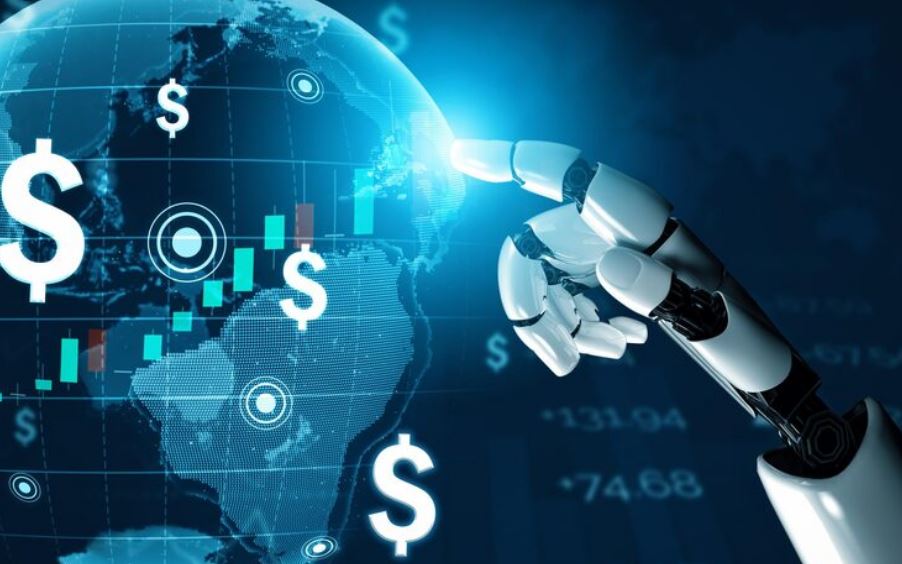
The trading floor’s appearance has changed. Most of the shouting has stopped. These days, screens—rows of screens—dominate, illuminating quiet desks where traders sit and watch numbers flicker and change more quickly than the eye can comfortably follow. Algorithms are already making choices somewhere behind those screens. Not recommendations. choices.
Although artificial intelligence has long been present in financial markets, it now seems more like an active participant than a background tool. More than half of finance functions currently employ AI in some capacity, according to recent estimates—a significant increase from a few years ago. On paper, that statistic seems clinical, but in reality, it indicates that machines are now assisting in the daily allocation of billions of dollars.
| Category | Details |
|---|---|
| Topic | Artificial Intelligence in Financial Markets |
| Key Institutions | IMF, World Economic Forum, Goldman Sachs |
| Adoption Rate | ~58% of finance functions using AI (2024) |
| Key Use Areas | Trading, Risk Analysis, Fraud Detection |
| Economic Impact | Potential $15.7 trillion contribution by 2030 |
| Reference | https://www.weforum.org |
It’s possible that most people were unaware of the change because it occurred so slowly. Years ago, hedge funds started utilizing machine learning models, quietly honing them and gradually increasing prediction accuracy. These models can now simultaneously analyze macroeconomic data, social media sentiment, and earnings reports, generating insights in a matter of seconds. As this develops, it seems as though human intuition—which was once crucial to investing—is being pushed aside or at the very least enhanced in ways that are hard to quantify.
A portfolio manager in a midtown office tower in New York looks at a dashboard that provides a real-time summary of market risks. Before he can even describe what appears out of the ordinary, the system flags anomalies. It is unquestionably efficient. However, it also begs the question of how much of this process he actually controls anymore, a question that persists longer than the alerts on his screen.
AI has clear market potential. quicker analysis, fewer mistakes, and better judgment. AI boosts forecasting, increases efficiency, and increases liquidity, especially in complex markets like corporate debt, according to organizations like the International Monetary Fund. And it appears to be effective in a lot of situations. Trades settle more quickly. The ability to detect fraud is improved. Back-office procedures that used to take days now only take a few minutes.
However, as markets have previously discovered, speed can be both an asset and a liability. There have already been instances where algorithmic trading seemed to increase volatility rather than reduce it, such as abrupt, sharp sell-offs. Although it’s still unclear how much of those movements were specifically caused by AI, the pattern is recognizable: trends that might have otherwise developed more slowly are accelerated by machines acting simultaneously.


Financial markets seem to be about to enter a phase where reactions take precedence over reflection. Prices change because a system recognizes a pattern and takes immediate action, not because a human has carefully considered the data. That does not necessarily mean that the choice is incorrect. However, it does subtly alter the market’s rhythm.
Though maybe not as quickly as the technology is developing, regulators are keeping an eye on things. Circuit breakers and other safety measures were implemented in response to incidents such as the 2010 flash crash. In a world where AI-driven systems can process and act upon information at previously unthinkable speeds, the question now is whether those tools are sufficient. Understanding who—or what—is causing crashes is just as important as preventing them.
AI is also lowering entry barriers in novel ways. With the help of sophisticated analytics tools, smaller businesses can now compete in markets that were previously dominated by big organizations. As AI models sort through enormous volumes of data to find opportunities, emerging markets—which are frequently disregarded because of their complexity—become more accessible. Although this democratization seems promising, there may be new risks involved, particularly if many participants use similar models.
Additionally, the human element persists despite the involvement of machines. Investors continue to decipher signals, determine when to believe them, and handle the fallout. However, there is a slight change in accountability as the use of AI grows. Is it the model’s fault, the developer’s fault, or the investor’s choice to trust it when a trade goes wrong? Sometimes the answer is unclear.
It’s difficult to ignore how rapidly expectations are shifting. AI in finance seemed experimental, even specialized, ten years ago. These days, it’s being incorporated into everything from customer service to high-frequency trading. The World Economic Forum has predicted that AI will eventually change financial markets, but in front of those glowing screens, it seems more like an ongoing change than a far-off one.
However, there is still uncertainty. New technologies, such as computers, the internet, and telegraphs, have always been accommodated by markets. Every time, the changes initially appeared disruptive before progressively returning to normal. AI might take a similar route. Alternatively, it might add unpredictable complexity, particularly as systems become more autonomous.
A quiet realization that financial markets are no longer just human arenas emerges as one watches this play out. They are evolving into hybrid systems that interact in ways that are still unclear, combining aspects of machine computation and human judgment. It remains to be seen if this results in increased stability or new types of volatility.
As of right now, traders are not completely replaced by machines. They are seated next to them, influencing choices, molding results, and subtly changing the way markets operate. Even though it doesn’t always make headlines, something fundamental is changing in that subtle shift.


