

 7:17 pm - March 12, 2026
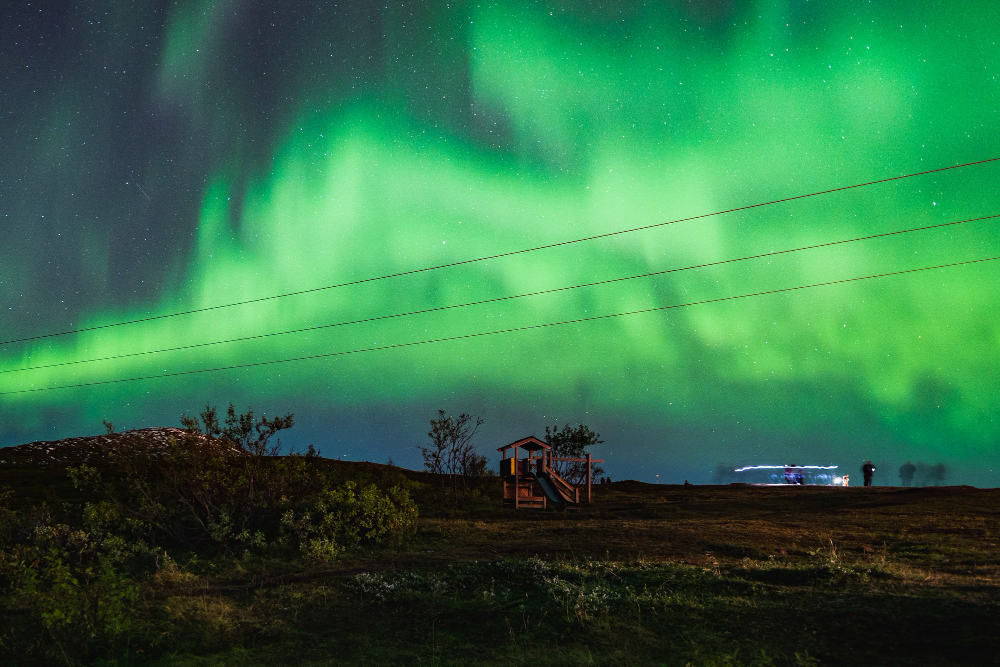
Sometimes the sky acts like an over-painted painter on a chilly March night in Fairbanks, Alaska. The first to emerge are green ribbons that slowly move through the shadows. Then, like smoke drifting over the horizon, come pinks and light purples. In frozen fields and parking lots, people congregate, standing silently and pointing their cameras skyward. “There it is,” someone invariably murmurs.
However, something strange is occurring this year. The aurora is no longer limited to the far north. The NOAA Space Weather Prediction Center’s geomagnetic storm forecast and increased solar activity have made the northern lights visible over a large portion of the United States, from Alaska to Maine.
| Category | Details |
|---|---|
| Phenomenon | Aurora Borealis (Northern Lights) |
| Cause | Solar winds and charged particles colliding with Earth’s atmosphere |
| Peak Activity | March 2026 geomagnetic storm linked to solar winds and CME |
| States With Strong Viewing Potential | Alaska, Washington, Idaho, Montana, North Dakota, South Dakota, Minnesota, Wisconsin, Michigan, Maine |
| Best Viewing Time | 10 p.m. – 2 a.m. local time |
| Best Locations | Dark rural areas away from city lights |
| Forecasting Authority | National Oceanic and Atmospheric Administration |
| Aurora Monitoring Center | NOAA Space Weather Prediction Center |
| Reference | https://www.swpc.noaa.gov |
For a few states, this is practically an unanticipated economic opportunity. Consider Alaska. For a long time, the state has promoted itself as the U.S.’s aurora capital, especially in the Fairbanks area, which is situated directly beneath the auroral oval. Travelers wearing thick parkas wait for the sky to ignite while tour buses sit in snowy parking lots outside of town. In the same way that fishermen used to track tides, local guides track solar wind data by whispering into radios.
These kinds of nights, according to travel agencies, cause a discernible increase in reservations. Hotels fill up fast. Cafés open later than usual at night. It’s difficult to ignore how an entire local economy can be affected by a cosmic event that started 93 million miles away on the sun.
The narrative shifts a little further south. Although auroras are not unheard of in northern Minnesota and Wisconsin, they seldom occur with such intensity. Photographers have been congregating after dark along Lake Superior’s frozen edges, erecting tripods along icy beaches where waves gently pound the rocks.
It appears that local tourism boards are conscious of the potential transience of the moment. While small businesses advertise aurora-watching weekends, social media posts urge locals and tourists to “look up tonight.” Some of this zeal may be opportunistic. However, the crowds indicate that something real is taking place.


Another interesting example is the Upper Peninsula of Michigan. Although the area is already well-known for its far-off scenery and gloomy skies, this March display has garnered fresh interest. Just before midnight, parking lots close to Lake Superior have been getting crowded. As this develops, it appears that northern lights tourism, which was previously primarily associated with Iceland or Norway, may be subtly expanding in the Midwest of the United States.
In theory, the science underlying the spectacle is simple. Shimmering waves of light are created when charged particles from the sun collide with gases in the Earth’s atmosphere. However, timing is important. Due to the Earth’s magnetic field aligning close to the spring equinox, March frequently experiences increased aurora activity. This is sometimes referred to by scientists as the Russell-McPherron effect.
The alignment occurs during a particularly active solar cycle this year. As solar activity peaks in the upcoming years, some astronomers predict even more powerful auroras. Although it’s still unclear if the displays will continue to be this common, travel agencies have already expressed interest in the possibility.
North Dakota and Montana are seeing a more subdued manifestation of the phenomenon. These states are surprisingly perfect for aurora viewing because of their vast open spaces, low levels of light pollution, and crystal-clear skies. Pickup trucks line gravel roads outside of small towns, and drivers get out to gaze skyward.
These scenes have a strangely communal quality. As they exchange predictions about whether the lights will get brighter, strangers exchange thermoses of coffee. Cameras click steadily. Every now and then, when a brilliant arc crosses the sky, someone applauds.
The aurora has a distinct mood in Maine. Above forests and coastal inlets, the lights can occasionally be seen faintly reflecting off the Atlantic. People in Aroostook County have been leaving their houses after dark to look for a glimmer of green.
It’s difficult to ignore the fact that the northern lights still seem a little enigmatic in the US as you watch this develop. They have become the focal point of entire tourism industries in Europe. In contrast, America has handled them more like a welcome surprise. Maybe that’s starting to change.
For the upcoming winters, travel companies are already advertising aurora-focused vacations. Northern states’ national parks are quietly getting ready for an increase in nighttime visitors. Downloads of smartphone apps that monitor solar storms are also increasing.
Auroras are still unpredictable, of course. The spectacle can be completely erased by a cloudy sky. Forecasts for solar wind can change hourly. However, part of the appeal may be uncertainty.
People seem to grasp something basic when they stand under a pitch-black sky in March and watch for a streak of green light to appear. Nature doesn’t plan shows based on demand. However, it feels like the nation has momentarily entered a different kind of theater when the lights finally appear, stretching across the sky from Alaska to Maine. And that theater’s ceiling is the sky itself for a few nights every year.