

 3:45 pm - March 5, 2026
Perhaps the most significant medical advancement of the next half century won’t be a novel medication or a ground-breaking operation. It might entail something more subdued: fewer people participating in the diagnostic procedure.
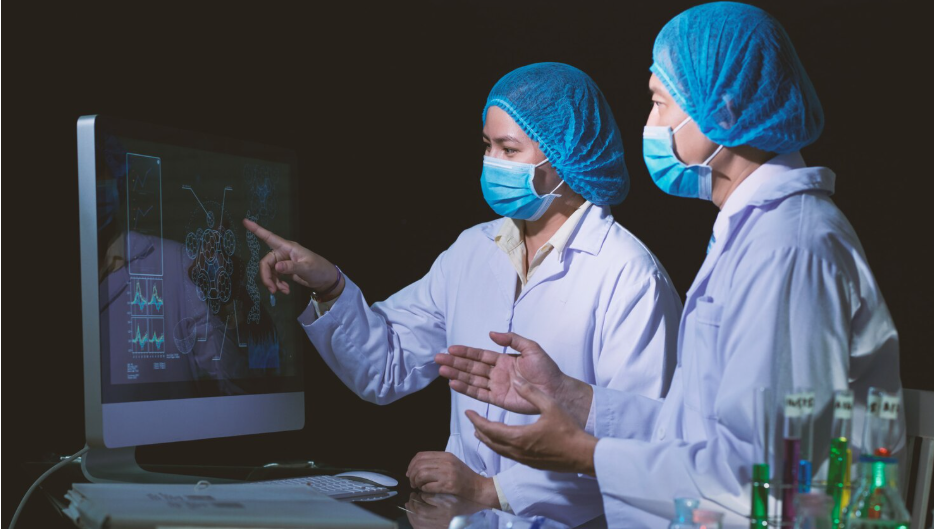
You can already feel the change if you stroll through a contemporary hospital today. Beside beds, screens glow. Servers silently processing scans hum in radiology labs. An AI-assisted imaging report that has already highlighted suspicious tissue before the human eye fully recognizes it is being scrolled through by a doctor in one corner. From the outside, medicine still appears to be human. However, machines are gradually approaching the center of the workflow.
| Category | Information |
|---|---|
| Field | Artificial Intelligence in Healthcare |
| Key Concept | AI-assisted diagnosis and decision-making |
| Influential Figure | Alan Turing |
| Emerging Trend | Algorithmic decision-making in medicine |
| Related Technologies | Machine learning, medical imaging AI, VR clinical environments |
| Ethical Concerns | Bias, transparency, patient trust |
| Industry Organizations | World Health Organization |
| Key Idea | “Algorithmic paternalism” in healthcare |
| Reference Source | https://www.who.int/health-topics/artificial-intelligence |
Actually, the story started decades ago, long before clinical algorithms and hospital data centers. The question sounded philosophical when Alan Turing proposed the well-known “imitation game” in 1950: could a machine appear intelligent enough to trick a human? It was less of an engineering roadmap at the time and more of a thought experiment. However, it’s difficult to avoid feeling as though Turing’s thought experiment surreptitiously slipped out of the lab when you’re standing in a contemporary radiology department with machines that analyze thousands of scans every hour.
Technology and medicine have always changed together, but the rhythm feels different now. The doctor’s authority was based on a lack of knowledge for centuries. Pain was reported by patients. It was interpreted by doctors. A paternalistic relationship—one person holding the knowledge, the other holding the suffering—was the result of this imbalance, according to historians. Something strange is happening right now. The very nature of knowledge is being automated.
These days, AI systems are able to identify abnormal heart rhythms before a nurse notices the monitor, predict complications in emergency rooms, and identify tumors in CT scans. Certain systems even provide doctors with a list of options before the human dialogue even starts by drafting treatment recommendations. As this is happening, it seems like the medical hierarchy is changing once more, this time in the direction of what scholars refer to as “algorithmic paternalism.” Although it sounds chilly, the truth is more nuanced.
Consider a patient who is seated in a calm consultation space. The doctor looks at an AI-generated diagnostic summary on a screen. Thousands of cases like this one have already been processed by the machine, which found patterns that would be impossible for a human to follow. The doctor continues to talk to the patient, reassure them, and explain the circumstances. However, it’s possible that the pattern recognition—the intellectual heavy lifting—has already taken place inside a model that has been trained on millions of data points. Surprisingly, some doctors privately acknowledge that when humans hesitate, the machines are sometimes correct.


AI decision-support systems, for instance, are starting to match or even surpass human performance in specific diagnostic tasks in emergency medicine. That does not imply that physicians are going extinct. Not at all. However, it does imply that the cognitive foundation of medicine—determining what is wrong—is becoming partially automated.
The cultural change is even more apparent outside of hospitals. Before ever visiting a doctor, more and more patients use chatbots to ask health-related questions, look up symptoms online, or communicate with automated triage systems. This trend was accelerated by the pandemic. While AI-powered symptom checkers subtly advanced, telemedicine made remote consultations more common.
It’s difficult to ignore the paradox as this change occurs: medicine may become more technological at the same time that the human role becomes more emotional.
As algorithms take care of risk modeling, diagnosis, and prediction, doctors might find themselves taking on a more traditional role that is similar to that of the first healers in human history. listening. Fear interpretation. guiding patients through uncertainty. Put differently, less computation. greater compassion.
Naturally, there is tension throughout the entire process. Training data, which is a major component of AI systems, frequently reflects current disparities. Algorithms may misinterpret symptoms or generate biased recommendations if particular populations are less represented in medical datasets. The World Health Organization and other regulatory bodies have started to issue warnings about these dangers, highlighting the importance of accountability, transparency, and supervision. Automation bias is a less obvious issue.
When a machine makes a confident recommendation, people are more likely to believe it, even if it’s incorrect. The psychology is obvious to anyone who has ever followed GPS directions into a dead-end street. The stakes are clearly higher in medicine. Clinical judgment may be subtly undermined in the future if physicians merely submit to algorithms.
However, once technological momentum starts, it rarely stops. Hospitals deal with aging populations, growing expenses, and a lack of staff. AI promises scalability, speed, and efficiency. Investors perceive a chance. Administrators observe improvements in workflow. Faster responses are seen by patients. It appears to be hard to reverse the direction.
The historical cycle that may be surfacing beneath all of this innovation, however, is perhaps the most fascinating possibility. When science had little to offer, human caregivers provided consolation, which is how medicine got its start thousands of years ago. Physicians became influential specialists as a result of scientific advancements. These days, machines are assimilating that knowledge. Thus, humans are left with a surprisingly familiar task: caring for others.
As this develops, there’s a weird sense that medical advancements may appear to be technologically sophisticated but emotionally archaic. diagnosing machines. algorithms for computation. data that forecasts results. Additionally, there is a human doctor sitting next to a patient in the room, explaining everything. That discussion might still be the most crucial aspect of medicine, despite the power of contemporary technology. For now, at least. And maybe longer than anyone anticipates.


