

 2:15 pm - March 4, 2026
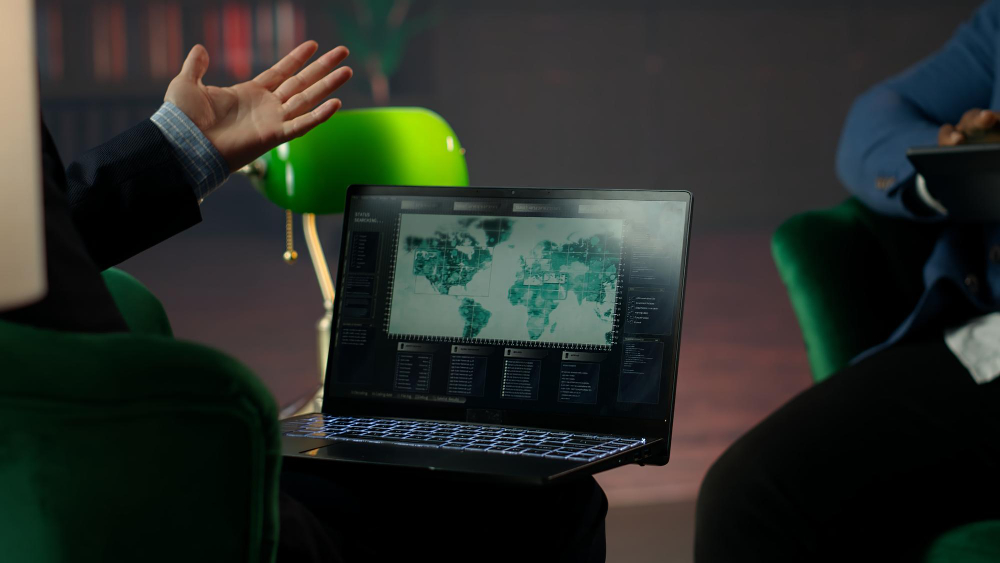
The strategy meeting on the 32nd floor of a glass tower in Seattle appears to be quite routine. cups for coffee. laptops. On a screen, slides flicker. But in many businesses like this, something a little out of the ordinary is taking place.
Not all of the analysis that fueled the discussion was produced by analysts working through the night, including pricing simulations, market forecasts, and even competitor predictions. It was silently generated by background-humming artificial intelligence systems.
| Key Information | Details |
|---|---|
| Topic | Artificial Intelligence in Corporate Strategy |
| Notable Companies Involved | Amazon, Moderna, McKinsey, Zillow |
| Key Trend | AI automating management tasks and influencing strategy |
| Strategic Shift | From hierarchical structures to AI-driven decision systems |
| Estimated AI Market Size | $200B–$700B today, projected $1T–$2T by 2030 |
| Reference Source | https://www.mckinsey.com |
Corporate strategy had a well-known routine for many years. Teams collected information, consultants wrote comprehensive reports, executives discussed the findings, and ultimately a strategy was developed. It’s difficult to ignore how that rhythm is starting to change when watching the process today.
Artificial intelligence is doing more than just speeding up business operations. In certain instances, it is quietly changing the way that organizations think.
Internal teams at organizations like Amazon and Moderna have begun experimenting with AI agents that can perform administrative and routine analysis tasks that previously took up managers’ time. It may seem insignificant, but it alters the nature of leadership.
In the past, managers reviewed reports and oversaw teams while spending a significant amount of their day in spreadsheets and productivity apps. Theoretically, managers can now concentrate on judgment and strategy as AI takes care of some of that digital clutter. Executives are still attempting to comprehend the outcome, which is flatter organizations.


Management levels are subtly vanishing from some companies. AI systems are faster than humans at tracking performance metrics, coordinating workflows, and analyzing operational data. Businesses start to pose an awkward question when the machines manage coordination.
Do we still require as many middle managers as we used to? One engineer joked at a technology conference in California last year that AI had turned into “the quiet new team member nobody hired.” Though there was a tinge of discomfort in the remark, the room laughed. There is proof that this change is already taking place.
Traditionally guardians of corporate strategy, consulting firms are developing their own AI tools to automate some aspects of their advisory work. Within minutes, certain internal platforms can test market reactions, create strategic frameworks, and model business scenarios. It’s feasible to envision a time in the future when strategy development resembles conducting experiments rather than brainstorming sessions after seeing how these tools work.
The situation isn’t totally clear, though. Many executives are still dubious about giving machines the ability to think strategically. After all, ambiguity, intuition, and sometimes irrational leaps of judgment are all part of strategy. Algorithms are very good at patterns, but human peculiarities in the workplace still make neat modeling difficult.
With a hint of humor, one executive recently explained it this way: AI can analyze ten million data points, but it still can’t comprehend a CEO who is stubborn.
Nevertheless, it is hard to ignore the momentum. Large datasets, such as market signals, supply chain interruptions, and consumer behavior, can be scanned by AI-driven decision systems to generate insights nearly instantly. Analysis that once took weeks now takes minutes. Businesses are being forced to reconsider their strategic tempo just due to the speed.
After just one quarter, plans that were supposed to last five years now seem out of date.
Under the surface, a structural shift is also taking place. Some businesses are experimenting with fluid “fusion teams,” which are groups that come together quickly around particular issues, in place of strict departments and reporting structures. AI tools assist in assigning workers to projects according to their availability, experience, and skill set.
Twenty years ago, this concept would have sounded crazy. It feels strangely useful today. For instance, Unilever has tried internal talent marketplaces that let workers switch between projects on the fly. AI systems suggest aligning skills with business requirements. As you observe these systems in operation, the organization starts to look more like a network than a hierarchy.
Networks also move in different ways. Startups and other smaller businesses are finding that AI levels some of the playing fields. With the help of strong AI tools, a small team can conduct market research and develop products with a level of sophistication that was previously only possible for large corporations.
Another troubling question is raised by that dynamic. What would happen to the conventional benefits of large corporations if speed and intelligence were more important than scale?
Investors are listening. AI, according to some, will condense decades of innovation into a much shorter period of time. Dario Amodei, the CEO of Anthropic, has referred to this potential as a “compressed century,” in which technological advancements occur at a rapid pace.
It’s unclear if that vision turns out to be accurate. Technology-related predictions frequently exceed reality before settling into something more commonplace.
However, there is a sense that something structural is shifting when you walk through corporate offices today, with their calm meeting rooms, dashboard-filled screens, and AI-generated insights scrolling in the background. The concept of strategy is evolving into a living system.
Plans are becoming less of fixed roadmaps and more of an evolving hypothesis for executives. AI continuously simulates, testing novel concepts and monitoring results in real time. Scientific experimentation starts to resemble the strategy process.
But there’s also a human component that won’t go away. Over-reliance on AI, according to some leadership experts, may erode interpersonal skills within companies. Workers still look to human leaders for recognition, empathy, and mentoring. Feedback can be produced by machines, but people can tell when encouragement is coming from software rather than real people.
In a recent discussion, an AI researcher at Canva put it bluntly: authenticity becomes more valuable as AI becomes more prevalent in the workplace. The odd paradox of the AI era might be encapsulated in that observation.
Artificial intelligence is subtly changing organizational structures, speeding up decision-making, and rewriting corporate strategy. However, businesses appear to be rediscovering the value of human judgment as more algorithms make their way into the boardroom.
The future doesn’t seem wholly robotic when you’re standing outside a factory or in a conference room watching executives discuss a strategy that was partially created by machines.


