

 1:41 pm - February 24, 2026
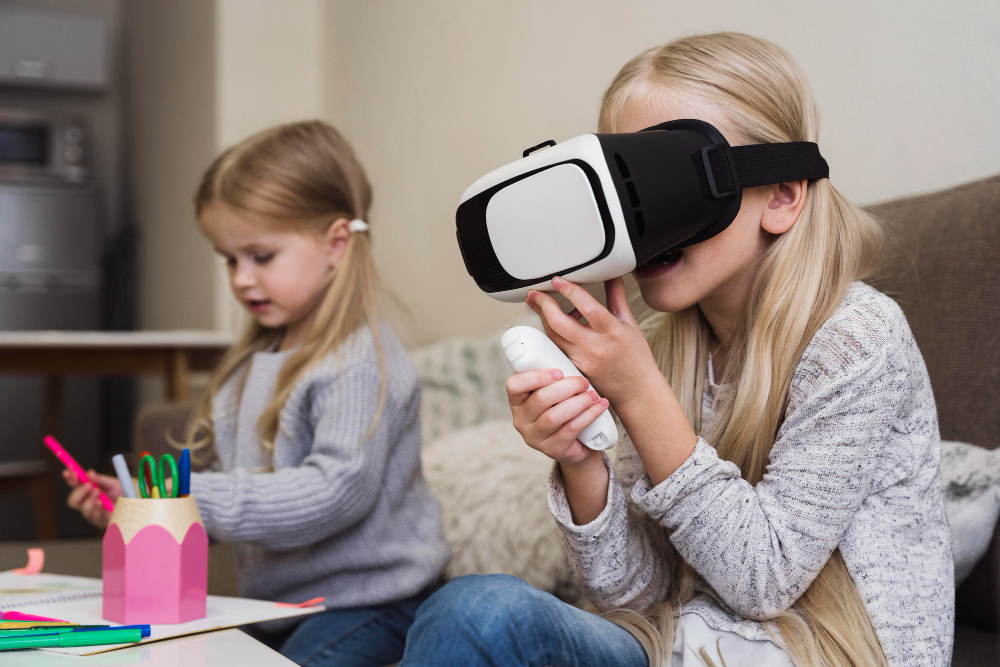
A nine-year-old is sitting cross-legged on the floor of a Brooklyn apartment on a weekday afternoon, leaning his tablet against a pile of textbooks. She requests an explanation of fractions from a chatbot. An answer appears in a matter of seconds, complete with detailed reasoning, colorful diagrams, and even a follow-up test. She taps, nods, and continues. No hand was raised. Don’t wait. No obvious struggle. It’s difficult to ignore how seamless learning has gotten.
These days, artificial intelligence permeates childhood in ways that are both familiar and unexpected. Before a parent can finish drying the dishes, voice assistants respond to inquiries. Real-time performance analysis and silent difficulty recalibration are features of adaptive math apps. The next science video that shows up is determined by recommendation engines. Though subtle, the change is pervasive.
| Category | Information |
|---|---|
| Research Institution | Harvard Graduate School of Education |
| Key Researcher | Ying Xu |
| Museum & Exhibit | Phillip and Patricia Frost Museum of Science |
| Featured Exhibition | AI: More Than Human |
| Example AI Tools | Voice assistants (Alexa, Siri), AI tutoring apps, adaptive learning platforms |
| Reference Source | https://www.gse.harvard.edu |
Ying Xu, a researcher at the Harvard Graduate School of Education, has been investigating how kids engage with AI systems. According to her research, AI can teach kids a lot, particularly if the systems are made to pose queries, encourage introspection, and mimic conversation. When compared to passive listening, young readers who interacted with AI companions in controlled studies demonstrated better comprehension.
That sounds encouraging. And it is in a lot of instances.
However, the interaction feels different from traditional learning in some way. The interaction is transactional when a child asks Alexa a question. Straightforward. Thin, maybe, but polite. There isn’t a raised eyebrow or an unplanned digression into a story about how the teacher first encountered the same idea. Human-to-human conversations stray. AI dialogues usually end.
Teachers in classrooms testing AI tutoring systems report a discernible change. With immediate corrections, students progress through the material more quickly. Algorithms are used to help draft essays. Weak areas are automatically identified. It works well. Nearly a surgical procedure. However, some teachers secretly question whether efficiency and comprehension are the same thing.


Learning has always come to children through hardship—through periods of disorientation that demand focus. That lag time is decreased by AI. Instant feedback reduces the amount of time spent sitting in uncertainty. This may alter children’s ability to handle hardship.
An intriguing finding from eye-tracking and pupillometry research, such as that displayed at the Frost Museum of Science’s AI exhibitions, is that children’s pupils dilate—until they stop—when tasks get too challenging. According to the data, when cognitive load becomes too much for them, they might stop participating. AI systems may be impeding the formation of resilience if they are constantly adapting to avoid that overload.
It’s difficult to overlook that tension.
Scalable personalization is promised by AI-powered platforms. An advanced student accelerates, while a struggling student receives focused support. This, in theory, creates an even playing field. And it does in a lot of ways. Tools that convert speech to text help kids with dyslexia. Multilingual classrooms benefit from translation algorithms. Accessibility has significantly improved.
However, experience is also limited by personalization. Algorithms serve content that is similar to what a child already enjoys in order to maximize engagement. Data patterns may serve as a more compelling guide for an inquisitive mind than haphazard exploration. Exploration becomes curated when YouTube suggests the next video based on viewing history.
It seems as though invisible hands are gently molding children’s curiosity.
The AI: More Than Human exhibition at the Phillip and Patricia Frost Museum of Science in Miami allows visitors to engage with intelligent systems and investigate how machines can learn from human input. Youngsters watch as their gestures are converted into digital responses while they stand in front of screens. It seems lighthearted. It’s almost mystical.
However, the exhibit also poses the silent question: do we start to adapt to AI if it adapts to us?
Young children frequently initially view AI as human-like. They express gratitude. They make jokes about it. They gradually come to understand its limitations. However, the social script shifts. Negotiating attention with a sibling is not the same as simply saying “Hey” to activate a system. Asking a chatbot to resolve a dispute avoids the convoluted process of debating with peers.
Whether this affects long-term cognitive development is still unknown. Research is still in its infancy. However, preliminary evidence points to AI having an impact on children’s thinking processes as well as what they learn.
Some educators contend that teaching kids to critically evaluate outputs, validate sources, and recognize bias is the solution—AI literacy. It seems sensible. After all, when television and the internet changed people’s attention spans, earlier generations had to learn media literacy.
This feels different, though.
AI creates information rather than merely presenting it. It can compose music, write essays, and solve equations. The line between help and substitution becomes hazy when kids outsource even a small amount of cognitive work. Use is how the brain grows. What takes the place of that work if AI takes over some of it?
However, it seems unrealistic to completely disregard AI. Playrooms, classrooms, and homework assignments already incorporate it. It might be more difficult to carefully manage its influence than to fight it.
A silent realization is emerging as you watch kids switch between textbooks and tablets: they aren’t just using AI to learn. They are learning with it, figuring out when to believe it, when to doubt it, and when to think for themselves.
It’s not that AI facilitates learning that’s odd. The reason is that it might be changing the very thought patterns that characterize learning, such as how long a child sits in perplexity, how thoroughly they investigate a concept, and how frequently they rely on their own logic before looking outside.
We might not fully understand the repercussions yet. However, the way kids learn to think is changing. Not in a big way. Not in a day.


