

 5:17 pm - April 10, 2026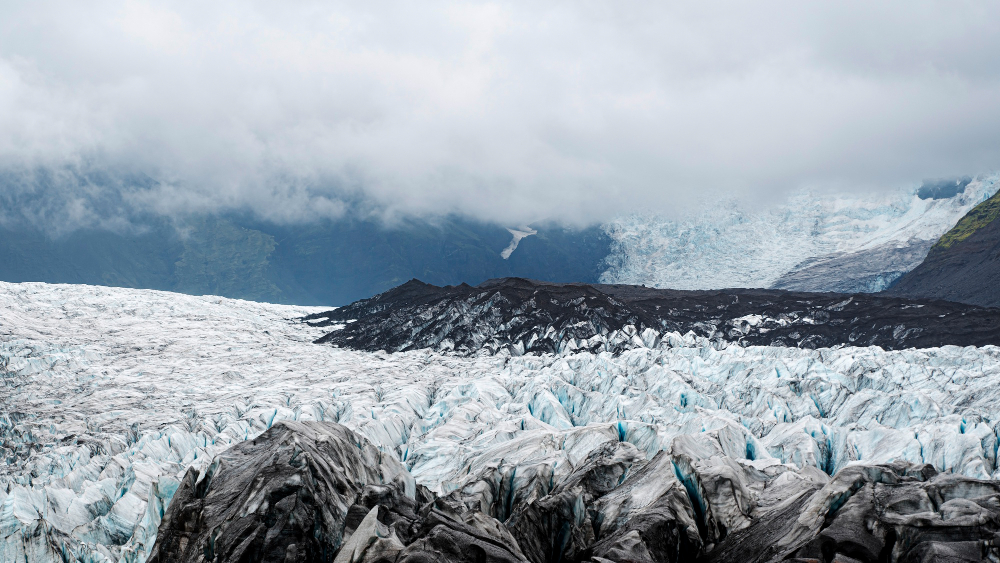
There are no spectacular explosions when the glaciers collapse high in the Himalayan air. Silently, almost courteously, they move away, exposing bare rock where old ice once lay. Standing in these mountain valleys gives one the impression that something ancient is gradually disappearing, much like memory fading.
According to scientists, these glaciers are melting 65 percent more quickly now than they were ten years ago. Until that number is converted into rivers, it seems abstract. Water is transported to almost two billion people by the Indus, Ganges, and Brahmaputra, all of which were formed from Himalayan ice. These rivers, which have influenced civilizations, might be about to enter a dangerously unpredictable phase.
| Field | Information |
|---|---|
| Region | Hindu Kush Himalayan Region |
| Nickname | “Third Pole” (largest ice reserve outside Arctic/Antarctic) |
| Population at Risk | Nearly 2 billion people downstream |
| Glacier Melt Rate | 65% faster in 2011–2020 vs previous decade |
| Major Rivers Affected | Indus, Ganges, Brahmaputra |
| Dangerous Glacial Lakes | Increased 51% since 1990 |
| Major Disaster Example | 2023 Sikkim flood killed 75+, destroyed hydropower dam |
| Ice Loss Projection | Up to 80% glacier loss by 2100 |
| Countries Affected | India, Pakistan, Nepal, China, Bhutan, Bangladesh |
| Reference | https://news.un.org |
First, rather than bringing less water, melting ice brings more.
The Indus River has been churning with unusual force in recent summers, and villagers along the river have noticed stronger currents. In order to irrigate fields that might otherwise dry out, farmers cautiously welcome the additional water. Scientists caution that this is only temporary. River flows will deteriorate after glaciers recede too much, leaving behind shortages that may persist for generations.
The paradox is that. Now flood. Later, I’m thirsty.
In addition to rivers, lakes that form above them also pose a threat.


Pools of meltwater left behind by retreating glaciers are encased in shaky rock and ice walls. Since 1990, the area of these glacial lakes has increased by more than 50%, indicating their rapid expansion. From a distance, they appear serene, their surfaces mirroring the peaks of the mountains. However, their silence is misleading.
The results are violent when they burst.
More than 75 people were killed in 2023 when a glacial lake collapsed in the Sikkim region of India, sending a wall of water roaring through valleys at night and destroying a massive hydropower dam. After hearing a distant rumble, survivors reported seeing chaos and darkness. It’s difficult to ignore how easily a tranquil setting can degenerate into a dangerous one.
These risks are now affecting entire communities.
Instable glacial lakes are only a few kilometers away from some villages in northern Pakistan. Knowing that the mountains above them are changing, families continue to farm, send their kids to school, and go about their daily lives as usual. Flooding caused by glaciers poses an immediate threat to an estimated seven million people in Pakistan alone. Relocating isn’t easy, though. They live in the mountains.
Systems of energy are also revealed.
In the Himalayan region, more than 250 hydropower plants rely on consistent glacial water. Dams can be destroyed by too much water. They are useless if they are too little. It seems as though infrastructure designed for stability is now confronted with instability on all sides as these projects develop.
At the heart of it all is climate change.
Ice melt is being accelerated by temperatures in the Hindu Kush Himalaya region rising more quickly than the global average. Snow absorbs more heat when black carbon, which is soot from burning wood and diesel engines, settles on it and darkens its surface. Whether international efforts to reduce emissions will proceed swiftly enough to mitigate the harm is still up in the air.
By 2100, scientists predict that at least one-third of the glaciers will have vanished, even under ideal circumstances.
The effects will be felt far beyond the valleys of mountains.
Millions of people in downstream cities like Lahore and Dhaka rely on rivers fed by the Himalayas for agriculture and drinking water. Reduced flows might force migration into already congested urban areas, raise prices, and interfere with food production. One gets the impression that the crisis isn’t limited to the mountains as you watch this develop. Already, it’s moving downstream.
A completely different landscape may be passed down to children growing up in these areas.
The glaciers that formerly delineated the horizon may disappear. Once-reliable rivers may start to exhibit seasonality. Communities that depend on dependable water cycles might have to adjust to unpredictability.
Preparations are being made.
Early warning systems are being installed by scientists to identify the collapse of glacial lakes. Plans for relocation are being studied by governments. However, these remedies feel incomplete because they address symptoms rather than root causes.
The mountains are still melting.
The size of the Himalayan ice collapse isn’t the only disturbing aspect of it. It’s the speed. Once taking centuries to develop, change is now occurring in a single lifetime. A sense of permanence is vanishing along with the ice.
Millions of people are waiting far below, observing the rivers and speculating about the future.