

 11:42 am - March 23, 2026
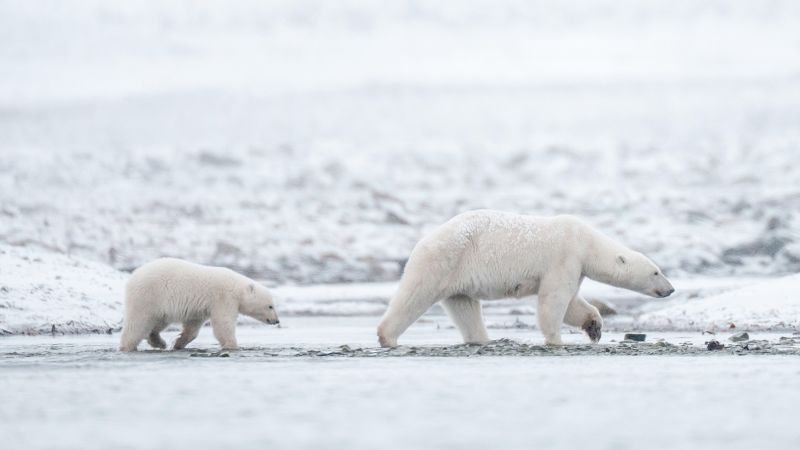
A population of polar bears in Norway’s Arctic Svalbard archipelago is defying global climate trends by gaining weight and improving health despite rapid sea ice loss, according to a study published Thursday in the journal Scientific Reports. While polar bear populations in regions such as Baffin Bay and Hudson Bay have experienced declining body condition and reduced reproduction as sea ice melts, the Barents Sea bears appear to be thriving through unexpected ecological adaptations.
Researchers from Norway, the United Kingdom and Canada analyzed 1,188 body measurement records from 770 adult polar bears collected between 1992 and 2019 on Svalbard. The study revealed that despite ice-free days increasing by approximately 100 days over this period, the polar bears actually became fatter and healthier after an initial decline from 1995 to 2000.
Polar Bears Adapt to Rapid Arctic Warming
The Barents Sea region, located off the northern coasts of Norway and Russia, has experienced temperature increases up to 2 degrees Celsius per decade in some areas. This warming has occurred faster than in other Arctic regions, causing the area to lose sea-ice habitat more than twice as quickly as anywhere else polar bears inhabit.
Despite these dramatic environmental changes, the bears have maintained and even improved their body condition. Researchers initially predicted the animals would become leaner as sea ice became less available for hunting seals, their primary prey.
Alternative Food Sources Support Bear Health
Lead study author Jon Aars, a population geneticist and senior researcher at the Norwegian Polar Institute, explained that the most likely explanation involves the bears exploiting alternative foraging opportunities. According to Aars, Svalbard polar bears have access to reindeer and bird eggs on land, walrus carcasses, and harbor seals as supplementary food sources.
Previous research had documented increasing numbers of bears spending more time on land during summer months, raiding bird nests in west Svalbard. Additionally, data showed more adult females in east Svalbard frequenting areas with bird colonies as sea ice diminished.


Climate Change Risks Remain for Polar Bear Populations
However, researchers emphasized significant caution about interpreting these findings. Aars stated that maintained body condition does not mean sea-ice loss has no effect, but rather suggests that Svalbard bears have been able to buffer some energetic costs associated with reduced ice availability up to now.
The study only examined one aspect of population health and did not assess overall population size, survival rates, or reproductive success. According to Aars, good body condition does not necessarily translate into stable reproduction, cub survival, or long-term population viability, and other demographic processes may already be negatively affected by sea-ice loss.
Animal biologist John Whiteman from Polar Bears International, who was not involved in the research, noted that body condition represents only one piece of the puzzle. Meanwhile, the study cannot predict how long the bears’ compensatory mechanisms will remain effective as climate change accelerates.
Local Conditions May Not Apply Elsewhere
The researchers warned that the buffering capacity observed in Svalbard may rely on local conditions not present elsewhere in the Arctic. These adaptive strategies may not persist if sea-ice loss continues or accelerates in coming decades.
Aars emphasized that the findings do not contradict the broader understanding that climate change poses serious risks to polar bears globally. Instead, the research underscores that climate impacts are complex and may involve temporary or partial compensation mechanisms specific to certain regions.
Continued monitoring of the Svalbard polar bear population will be necessary to determine whether these animals can maintain their current health as Arctic warming progresses and whether similar adaptation patterns emerge in other polar bear populations facing habitat loss.