

 9:04 am - March 23, 2026
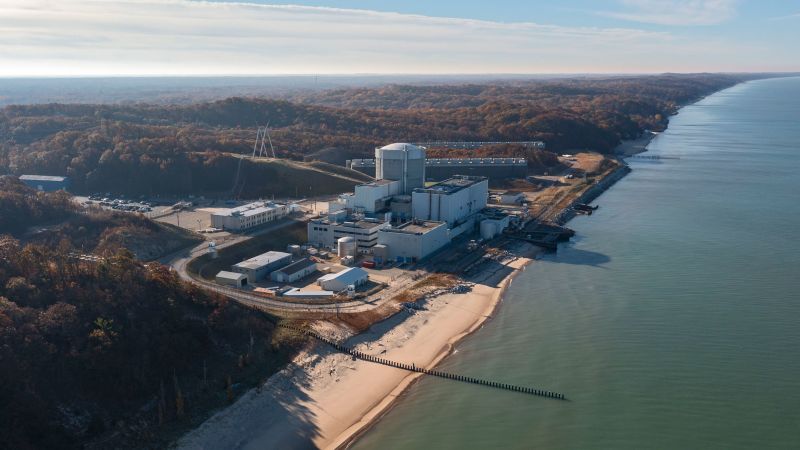
The Palisades nuclear plant in Michigan is poised to become the site of America’s first commercial small modular reactors, marking a potential turning point in the nation’s nuclear energy landscape. Florida-based company Holtec is reviving the facility, which was decommissioned in 2022, and plans to install two small modular reactors alongside restarting the plant’s conventional 800-megawatt reactor. If successful, the project will demonstrate not only the first-ever restart of a shuttered US nuclear plant but also prove the viability of small modular reactor technology on American soil.
The company initiated the formal licensing process with the Nuclear Regulatory Commission last month, according to a Holtec spokesperson. The company aims to secure full approval by 2029 and bring the small modular reactors online by 2031. Holtec plans to manufacture the 300-megawatt reactors at its Camden, New Jersey, factory before transporting them to the Palisades site in Covert Township, Michigan, located approximately two hours from Chicago.
Understanding Small Modular Reactors and Their Growing Appeal
Small modular reactors represent a new generation of nuclear technology designed to address longstanding challenges in the industry. According to Michael Craig, an associate professor of energy systems and climate at the University of Michigan, these reactors are in an ideal position with significant promise and potential. The technology offers the prospect of abundant, carbon-free power that operates continuously, making it particularly attractive to technology companies facing exponential energy demands from data centers and artificial intelligence operations.
The fundamental advantage lies in the name itself. First, these reactors are significantly smaller than conventional nuclear plants, which can cost tens of billions of dollars to construct. Nuclear engineer and independent consultant Nick Touran described small modular reactors as a technological solution to a financial problem, noting that venture capitalists cannot feasibly fund $30 billion projects but might manage investments in the hundreds of millions range.
Additionally, the modular aspect means these reactors can be mass-produced in centralized factories and delivered to sites. This approach promises to make them cheaper and more flexible than traditional massive nuclear installations. However, only three operational small modular reactors exist globally—one on a Russian barge off the Siberian coast and two in China—with none currently operating in the United States.
Competition Intensifies in the Race to Deploy Commercial Reactors
Meanwhile, Holtec faces competition from other companies pursuing commercial deployment. California-based Kairos Power broke ground in Oak Ridge, Tennessee, on a demonstration reactor in 2024, targeting operational status by 2028. The company plans to have a commercial-scale reactor producing grid electricity by 2030, using molten fluoride salt as coolant instead of water.


Allison Macfarlane, director of the School of Public Policy and Global Affairs at the University of British Columbia and former Nuclear Regulatory Commission chair, noted that Kairos is one of the few US companies actually building reactors currently. The company’s iterative approach of building, testing, learning, and rebuilding may provide invaluable insights, though success remains uncertain, she told CNN.
In contrast, Holtec’s technology is based on proven conventional water-cooled nuclear power plants. According to Brendan Kochunas, an associate professor at University of Michigan Nuclear Engineering and Radiological Sciences, using this established technology represents a sensible approach that should ease licensing and supply chain processes.
Technology Giants Pour Billions Into Nuclear Development
Big Tech companies are betting heavily on advanced nuclear technology. In 2024, Kairos signed an agreement with Google to deploy a fleet of reactors totaling 500 megawatts—sufficient to power approximately 300,000 homes—with the first scheduled for 2030 operations. While Kairos declined to confirm the deal’s value, the company indicated it would support factory production line development and accelerate the learning curve.
Amazon invested in Maryland-based X-Energy, which employs a gas-cooled design and is planning up to 12 reactors at a new Washington state facility. Earlier this month, Meta announced an agreement with startup Oklo to prepay for power and develop a campus in Pike County, Ohio, supporting Meta’s regional data centers. An Oklo spokesperson told CNN the complete project buildout would represent a multi-billion dollar infrastructure investment, though specific figures were not disclosed.
Government Support and Financial Backing
Public funding is also flowing into the sector. In December, the Department of Energy approved $800 million toward developing small modular reactors, with $4 million allocated to Holtec. Rian Bahran, deputy assistant secretary for nuclear reactors, stated that deploying advanced reactors is a priority for the Trump administration and additional funds will be invested in research, development, and deployment.
However, this support comes with an ironic historical context. According to Touran, the US operated dozens of small reactors in the 1950s and 1960s, all running uneconomically. The industry subsequently pursued economies of scale, building larger plants. Nuclear’s inherent complexity made constructing bespoke mega-projects difficult, leading to delayed timelines, spiraling costs, and industry stagnation as cheap fracked gas dominated the market.
Experts Raise Concerns About Cost and Safety
Despite enthusiasm, some experts are sounding warnings. Edwin Lyman, director of nuclear power safety at the Union of Concerned Scientists, argues that small modular reactors face a fundamental cost problem. He told CNN that nuclear power cannot compete economically with alternatives including fossil fuels and increasingly affordable renewable energy. While reactors may have lower initial price tags, the electricity they produce will be far more expensive than wind, solar, or gas, he warned.
The Nuclear Regulatory Commission has approved only one reactor design so far, by NuScale Power, but a project to build them in Idaho was canceled in 2023 as costs soared and insufficient utilities committed to purchasing electricity. Neither Kairos nor Holtec would confirm their reactor costs, citing commercial sensitivity.
Furthermore, unconventional designs cooled by salt or gas often require high-assay low-enriched uranium, known as HALEU. Available quantities are limited and the supply chain has been dominated by Russia despite domestic supply development efforts. Touran identified this as a major risk, noting that relying on luxury, expensive fuel may not optimally compete with natural gas.
Safety concerns have also emerged as the Trump administration focuses on expediting licensing and loosening regulatory requirements. Lyman fears insufficient time for proper safety and security evaluation, describing the situation as the Wild West. In contrast, Kochunas believes that properly managed fast-tracking does not inherently threaten safety. The Department of Energy rejected claims that safety would be compromised, with Bahran stating the department upholds the highest safety standards in nuclear industry work.
As companies compete to demonstrate whether small modular reactors can meet expectations, the coming years will reveal if this technology can economically deliver on its promise. The timeline for proving commercial viability remains uncertain, with some experts questioning whether decades-long development periods align with immediate clean energy needs and rapidly evolving technology demands.


