

 4:54 am - March 23, 2026
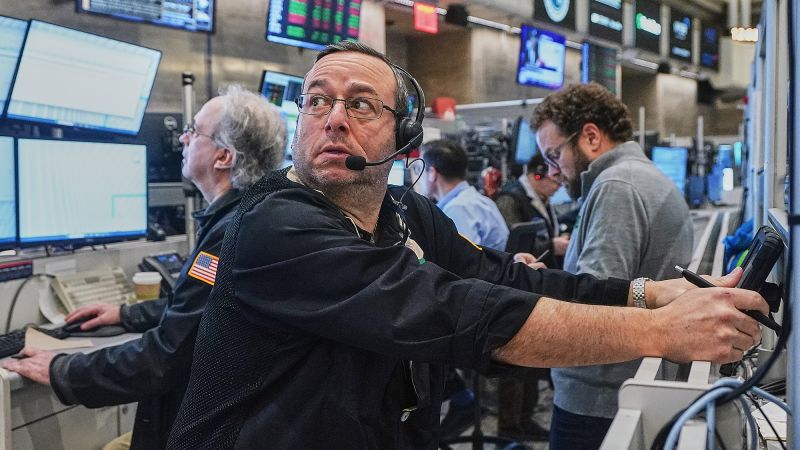
Major US stock indices declined Tuesday as market volatility intensified, with bitcoin tumbling to its lowest point since November 2024 amid growing investor anxiety. The cryptocurrency dropped nearly 7 percent earlier in the session, briefly falling below $73,000 before recovering to trade around $76,800, according to market data. Market volatility affected multiple asset classes as traders grappled with concerns about artificial intelligence disruption and geopolitical tensions.
The Dow Jones Industrial Average closed down 167 points, or 0.34 percent, after declining as much as 575 points during intraday trading. The S&P 500 fell 0.84 percent while the tech-heavy Nasdaq Composite sank 1.43 percent. Both the S&P 500 and Nasdaq posted their worst single-day performance in two weeks, with technology and software stocks leading the downturn.
Bitcoin Volatility Signals Risk-Averse Market Sentiment
The sharp decline in bitcoin reflected broader risk-averse sentiment sweeping through financial markets. The cryptocurrency has fallen roughly 40 percent since reaching a record high above $126,000 in October. Despite the Trump administration’s vocal support for pro-crypto policies and promises to establish the United States as the “crypto capital of the world,” bitcoin has struggled to regain momentum.
The cryptocurrency has languished despite support from Washington, experiencing significant price swings and multiple sell-offs since its autumn peak. According to FactSet data, gold has now outperformed bitcoin over the past five years, signaling a shift in investor preferences during uncertain times.
Gold Emerges as Preferred Safe-Haven Asset
Meanwhile, precious metals surged as investors sought traditional safe-haven assets. Gold futures jumped 6.7 percent to $4,965 per troy ounce, while silver futures soared 10 percent to approximately $85 per troy ounce. The rally in gold prices underscored its renewed status as the dominant store-of-value asset during periods of economic uncertainty.
Gerry O’Shea, head of global market insights at Hashdex, noted that bitcoin’s divergence from gold indicates most investors currently view the precious metal as superior during times of currency debasement, geopolitical turmoil, and macroeconomic uncertainty. However, O’Shea said he expects continued near-term volatility for bitcoin as the cryptocurrency industry seeks regulatory clarity and integrates into mainstream financial infrastructure.


AI Disruption Fears Pressure Software Stocks
Technology stocks faced particular pressure following announcements from artificial intelligence startup Anthropic. The company unveiled new capabilities for its Claude chatbot on Tuesday, including features that assist with legal work tasks. The announcement intensified fears that AI advances could disrupt traditional software companies serving the legal industry and other professional services sectors.
Additionally, recent concerns about AI threatening established software business models contributed to the sell-off. Salesforce shares dropped 6.85 percent as investors reassessed the competitive landscape. According to Daniel Skelly, head of Morgan Stanley’s wealth management market research and strategy team, rotation within the technology sector itself reflects investors fleeing software stocks due to AI-disruption concerns while moving toward other areas like memory chips.
Major technology companies experienced significant declines, with Microsoft falling 2.87 percent and Amazon dropping 1.79 percent. Nvidia, considered the flagship stock of the AI trade, declined 2.84 percent, adding downward pressure to broader market indices. The Nasdaq has fallen 3.18 percent from its October record high, while the Dow remains less than 1 percent below its January peak.
AI Spending Concerns Weigh on Tech Giants
In contrast to the broader market weakness, Walmart shares gained 2.94 percent, pushing the retailer’s market capitalization above $1 trillion for the first time. Wall Street has raised lingering questions about the profitability of massive AI investments and whether companies’ enormous capital expenditures will ultimately deliver adequate returns. Microsoft shares plunged 10 percent last Thursday, erasing nearly $360 billion in market value, after reporting slower-than-expected cloud sales growth despite increased AI spending.
Investors are increasingly scrutinizing corporate earnings reports and spending forecasts during the current earnings season. Traders are focusing intensely on how companies plan to generate profits sufficient to justify their substantial technology investments and capital outlays.
Geopolitical Tensions Amplify Market Uncertainty
Market losses accelerated following reports that the United States shot down an Iranian drone approaching a US aircraft carrier. The incident heightened geopolitical concerns and contributed to increased volatility across asset classes. Oil futures rose in response to escalating US-Iran tensions, with Brent crude gaining 1.6 percent to $67.33 per barrel and West Texas Intermediate climbing 1.7 percent to $63.21 per barrel.
The VIX volatility index, often called Wall Street’s fear gauge, jumped 10 percent after briefly soaring as much as 25 percent. The index temporarily traded at 20 points, a threshold indicating elevated market volatility. CNN’s Fear and Greed Index shifted from “greed” into “fear” territory, reflecting the deteriorating investor sentiment. The US dollar index declined 0.28 percent, pausing after a strong two-day rebound.
Market participants will continue monitoring developments in the AI sector and geopolitical situation for signals about future direction. The timing and details of any potential de-escalation in US-Iran tensions remain uncertain, as do regulatory developments affecting the cryptocurrency industry.